Primary Isotopes

LGA Model

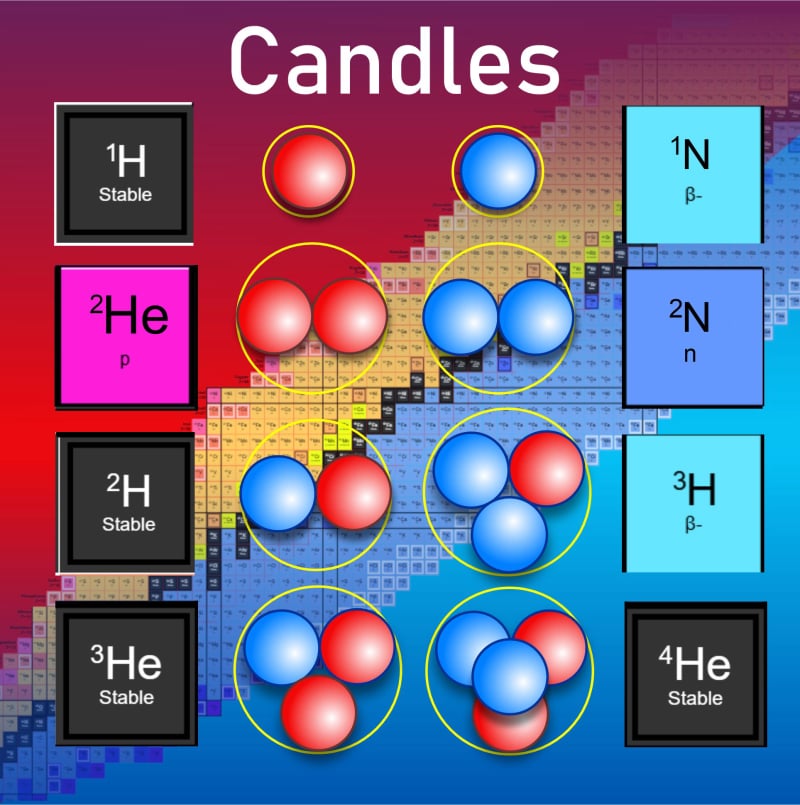
The Liquid Gravity model utilizes primary "Candle Isotopes" to map and define precise nuclear binding data measurements. Far from being mere structural building blocks, the primary eight isotopes establish the fundamental baseline values and key interactions that govern all atomic structures.

Primary Isotopes

The Foundation of Atomic Binding Data
Primary isotopes provide the foundational data required to calculate binding values across the entire periodic table. In astrophysics, Type Ia supernovae serve as "standard candles" to measure cosmic distance and time. In a similar fashion, the Liquid Gravity Atomic Model (LGAM) identifies specific Candle Isotopes. These specialized isotopes possess clearly defined values and interactions that allow us to unlock the structural and binding data of any atom.

While the first eight primary isotopes establish our baseline values, larger isotopes with highly symmetrical structures act as Celebration Candles. These are used to calculate gravitational curves—patterns that become vividly apparent in elements like Carbon, Oxygen, and Iron.

Equivalents of Gravity, Charge, and Binding Energy
Mainstream science treats gravity, charge, and binding energy as distinct phenomena, describing each through its own unique set of laws, equations, and units. Conversely, the LGAM integrates these forces, utilizing binding energy as a unifying metric that quantifies the collective interactions within the atomic nucleus.

In this framework, binding energy represents the "missing mass" of the nucleus, displaced by opposing forces acting at the localized contact points ("kiss points") between nucleons. By identifying the forces at each kiss point and mapping them to corresponding MeV values, the LGAM clarifies how these distinct forces interact, offering a high-resolution, highly accurate view of nuclear dynamics. Ultimately, the model relies primarily on gravity and charge, attributing measurable MeV values to their respective influences.

What about the strong force?
Conventional physics relies on the strong force to describe interactions between quarks and gluons, suggesting that a "residual" strong force binds nucleons together at short distances. The LGAM, however, proposes that gravity and electromagnetic forces are what actually bind nucleons. In this model, the strong force is interpreted as a localized hydraulic force generated by the vortices spinning between quarks, which operates independently and does not impact the overarching binding energy.

Gravitational Tidal Effects
Nucleonic charges exhibit a diverse spectrum of values—ranging from attraction and neutrality to strong repulsion—which interact uniformly throughout the nucleus. In exceptionally small atoms, these localized charge forces can dominate, driving the formation of halo and crested nuclei.

Conversely, for the majority of atoms, gravity exerts primary structural control; gravitational strength escalates as nucleons accumulate, organizing the cluster into its spatial geometry. Smaller atoms possess more localized, "clumpy" gravitational zones that exert a dramatic effect on structural geometry. In contrast, larger atoms exhibit consolidated gravity that uniformly increases from the outer layers toward the core. Consequently, larger atoms feature progressively weaker gravitational outer layers, allowing charge forces to become dominant over gravity and leading to structural instability.

Larger Candle Isotopes
While the LGAM currently lacks a closed-form equation to calculate this gravitational transition across the periodic table, it utilizes the aforementioned Candle Isotopes to empirically derive these values. At this larger scale, Candle Isotopes are defined by their complete sets of structural levels, providing a uniform, symmetrical calibration reference that can be systematically transitioned to the next Candle Isotope reference point.

Gravitational Distribution
The diagram below illustrates how gravity distributes across multiple nucleons, transitioning from a clumpy architecture in smaller atoms to a consolidated structure in larger ones. Binding energy is primarily influenced by the spatial location of the kiss points relative to this gravitational gradient. This mechanism explains why the Liquid Drop Model (LDM) demonstrates higher accuracy with larger atoms—where the gravity distribution is regular—yet suffers from low predictive accuracy for smaller, gravitationally clumpy elements.
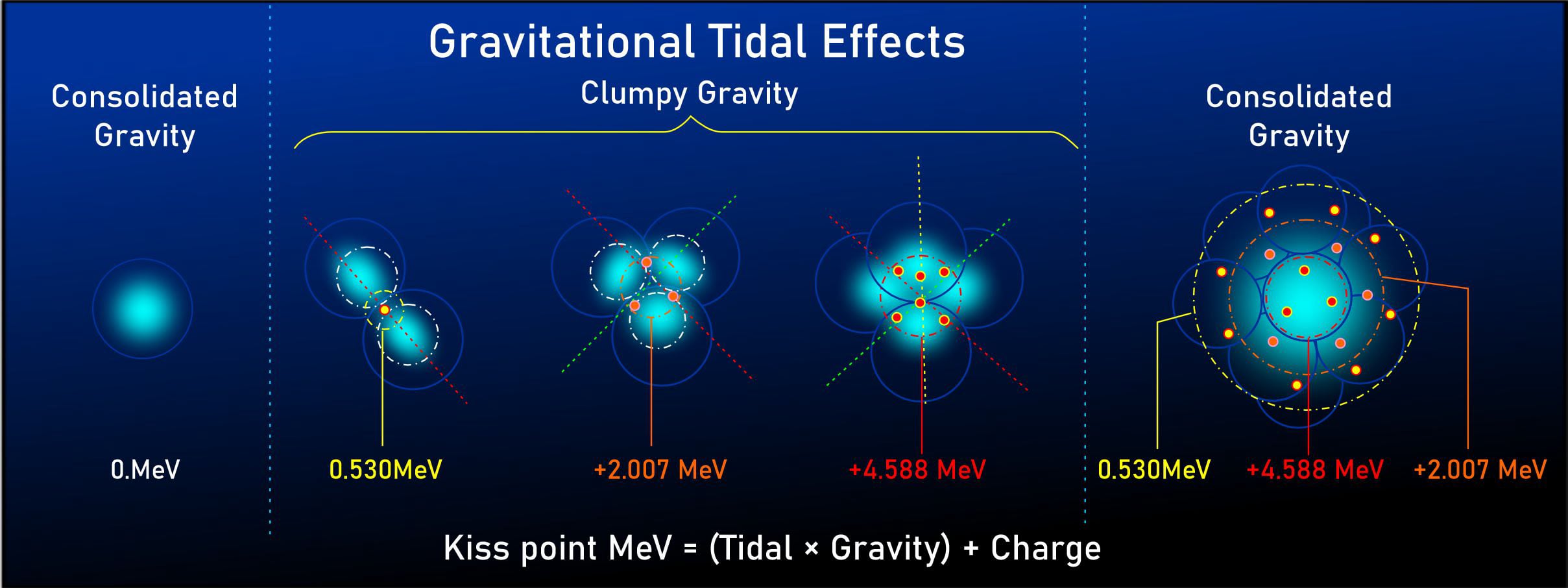
    

Nuclear Tidal effects

Protons & Neutrons

Single Proton
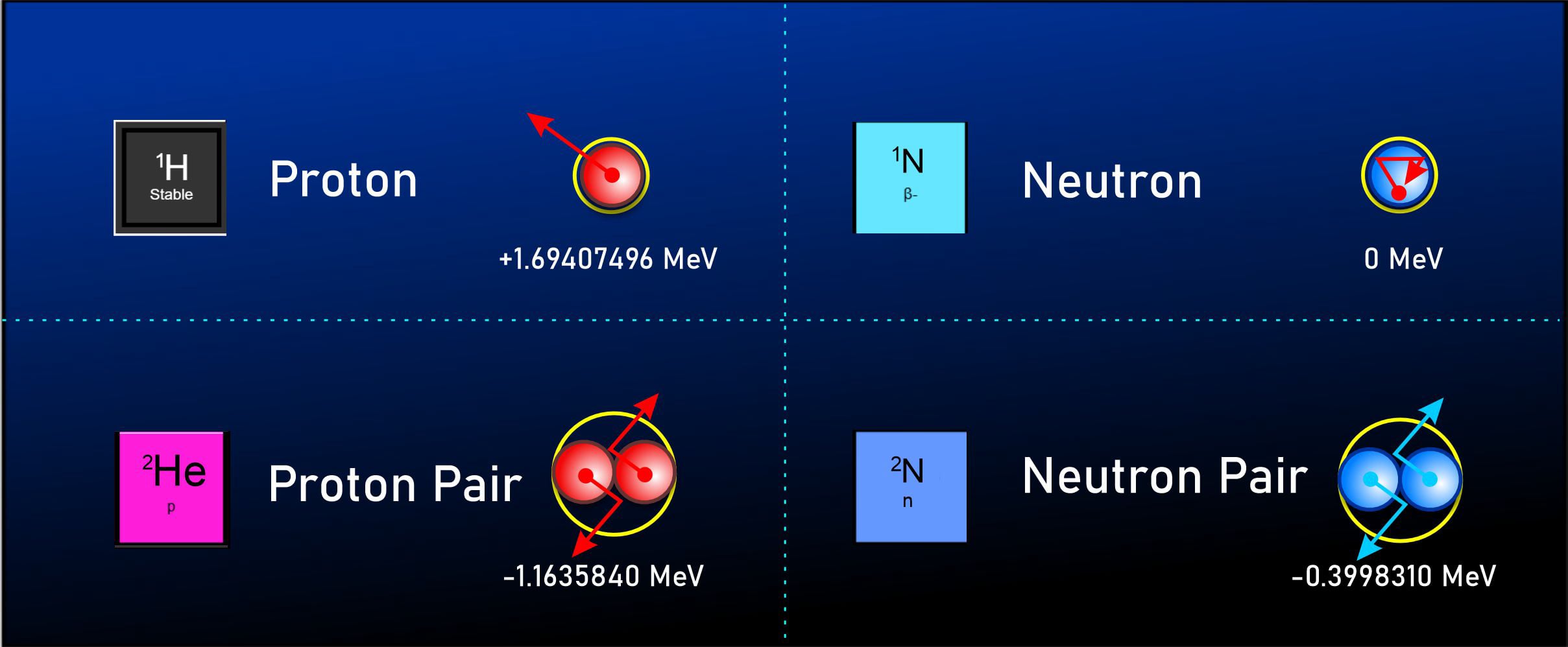
A proton on its own has a positive +1 charge, which equates to a value of +1.69407496 MeV. This is calculated using Coulomb's law based on the electrical attraction of opposite charges at a physical distance of 0.85 fm.

Proton Pair
A proton pair experiences a baseline repulsive force of -1.69407496 MeV at a distance of 0.85 fm, which is the boundary distance at which they physically make contact. Simultaneously, the pair shares a base gravitational attraction value of +0.53049097 MeV.
The combined net force between two protons is evaluated using the LGA baseline formula:
Charge + (Gravity × Tide Value) = MeV:

Kiss point 1 (P1~P2): -1.69407496 MeV + (0.53049097  MeV × 1) = -1.16358399  MeV

While an isolated, stable proton-proton pair cannot be directly evaluated via standard experimental measurements, this localized repulsive baseline is vital for calculating the energy distributions of heavier isotopes.

Single Neutron
An isolated neutron has a net charge of 0 MeV on its own. However, when it forms an active circuit with an adjacent proton, it acts as an extension of the proton's positive charge field—effectively adopting the same baseline value of +1.69407496 MeV at a contact distance of 0.85 fm.
While mainstream science views the neutron as fundamentally neutral, the LGA model posits that the localized negative quarks inside the neutron structurally align with the positive quarks of the proton to establish a closed charge circuit.

Neutron Pair
A neutron pair exhibits an inherent repulsive force of -0.93032195  MeV  at a contact distance of  0.85 fm, balanced against the universal nucleon gravitational attraction of +0.53049097 MeV.
The combined net force between adjacent neutrons is evaluated using the baseline formula:
Charge + (Gravity × Tide Value) = MeV:

Kiss point 1 (N1~N2): -0.93032195 MeV + (0.53049097 MeV ×1) = -0.39983098 MeV

This specific calculation is utilized whenever two neutrons reside adjacent to one another within a complex nucleus. The precise repulsive value of -0.93032195 MeV is derived mathematically from the structural geometry of Hydrogen-3 (Tritium).


Protons and Neutron Attractions

Hydrogen 

 Hydrogen-2 (Deuterium)

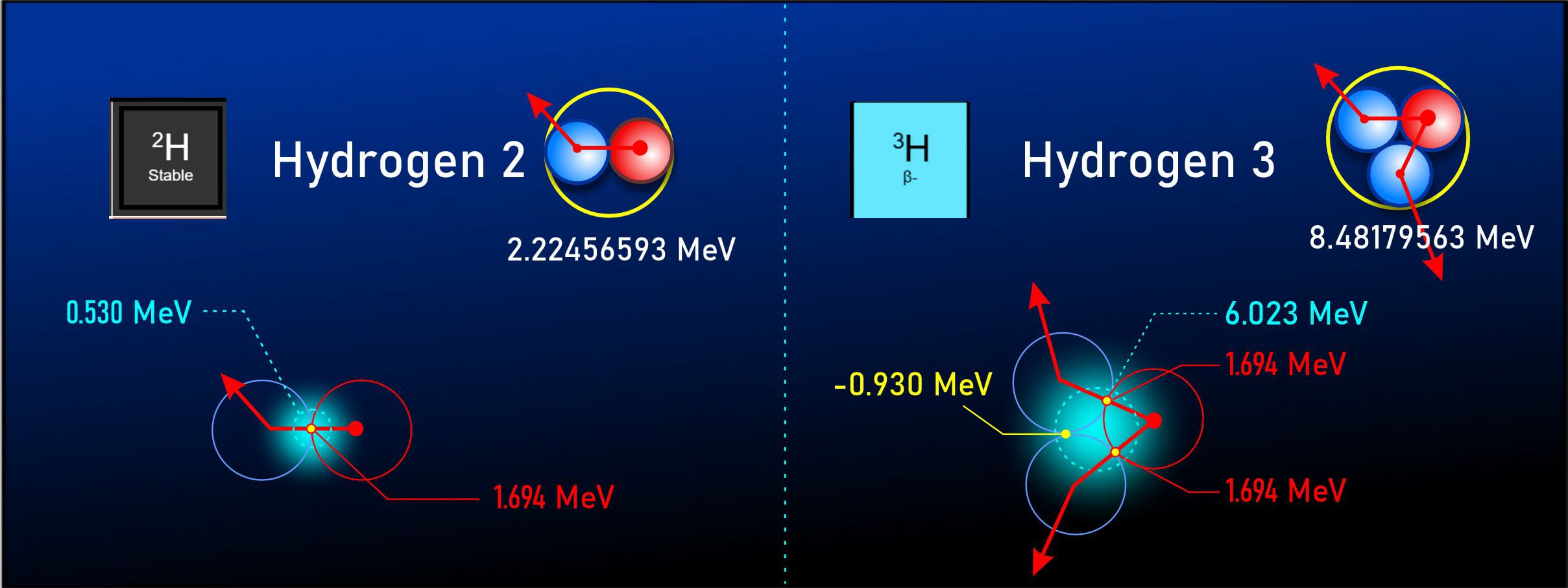
Hydrogen-2 comprises a proton and a neutron, with a total measured binding energy of 2.22456593 MeV. The LGA model posits that the positive proton attracts the negative quarks within the neutron, combining to form a circuit chain with an baseline electrical attraction of +1.69407496 MeV.
The remaining balance of 0.530490970 MeV represents the base gravitational attraction value that exists between all nucleons within a nucleus. Unlike electrical charges, which remain uniform at identical distances, this gravitational value is subject to tidal variations that can increase or decrease based on the distance from the center of mass. These core rules serve as the foundation for all isotope calculations within the LGA Model.

Hydrogen-2 features 1 distinct kiss point evaluated using the baseline formula: Charge + (Gravity × Tide Value) = MeV

Kiss point 1 (P1~N1): +1.69407496 MeV+ (0.53049097 × 1) = 2.22456593  MeV

Total Calculated Binding Energy: Sum of all kiss points = 2.22456593 MeV

Hydrogen-3 (Tritium)

Hydrogen-3 consists of two neutrons and one proton, with a total measured binding energy of approximately 8.48 MeV. Because there is no simple scaling ratio that applies uniformly across isotopes, the measured value must be deconstructed using the established framework of the LGA Model. This requires identifying the physical contact points, termed "Kiss points," and calculating their localized values based on inter-nucleon relationships.
A key insight revealed by the H3 isotope is the negative potential of -0.93 MeV between the neutron pair. This is derived by comparing it to 3He, which shares a comparable structural geometry; deducting these known values from the total measured binding energy isolates the localized repulsive force.

Hydrogen-3 features 3 distinct kiss points evaluated using the baseline formula: Charge + (Gravity × Tide Value) = MeV

Kiss point 1 (P1~N1):  +1.694  MeV  + (0.5305 MeV × 3.7852) = 3.702  MeV 
Kiss point 2 (P1~N2):  +1.694  MeV  + (0.5305 MeV × 3.7852) = 3.702  MeV 
Kiss point 3 (N1~N2):  -0.930  MeV  + (0.5305 MeV × 3.7852) = 1.078  MeV 


Total Calculated Binding Energy: Sum of all kiss points = 8.482 MeV
(Raw high-precision total: 8.48179563 MeV)


Helium

Helium-3

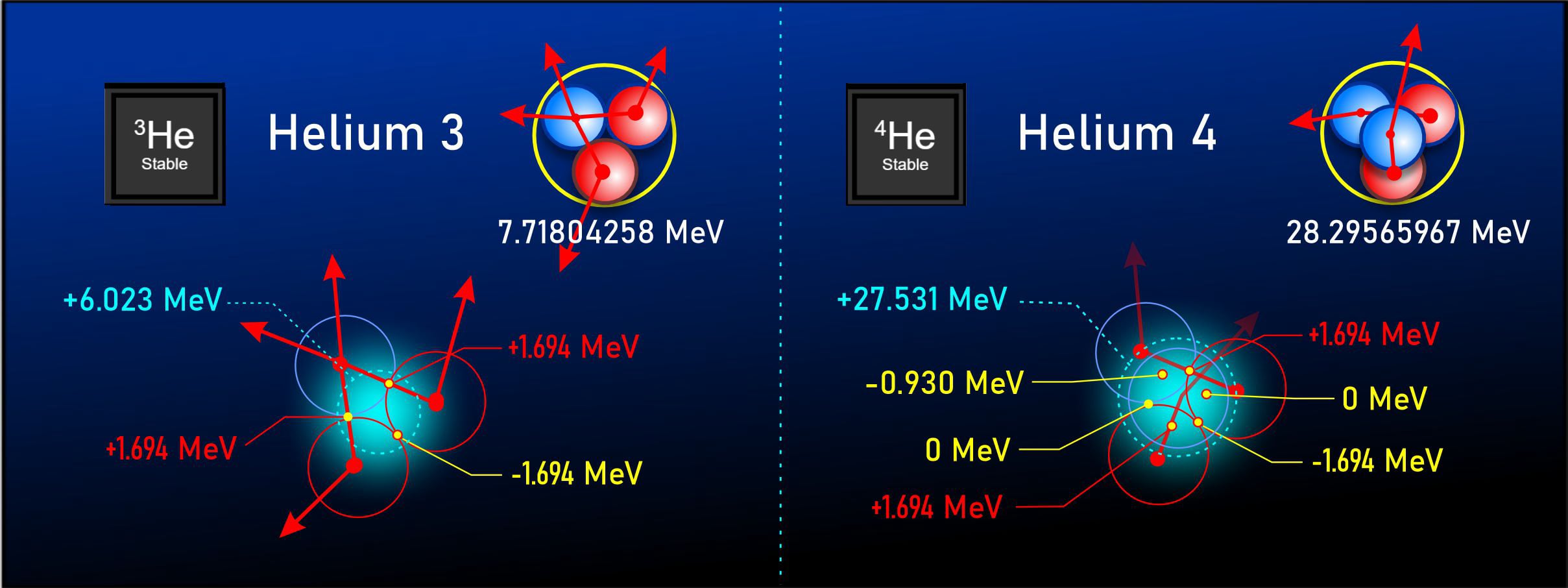
Helium-3 consists of two protons and one neutron, with a total measured binding energy of approximately 7.718 MeV. Utilizing the foundational framework established in the H2 model, we incorporate two positive charge values of +1.694 MeV and introduce a negative repulsive charge value of -1.694 MeV assigned specifically to the proton-proton pairing.

The resulting net energy balance illustrates how local gravitational influence increases threefold upon the addition of a single nucleon. This mechanism represents the LGA Model's tidal effect in action, yielding a gravitational baseline value applicable to H3.

Helium-3 features 3 distinct kiss points evaluated using the baseline formula: Charge + (Gravity × Tide Value) = MeV

-Kiss point 1 (P1~P2): -1.694 MeV + (0.5305 MeV × 3.7852) = 0.314 MeV 
-Kiss point 2 (P1~N1): +1.694 MeV + (0.5305 MeV × 3.7852) = 3.702 MeV 
-Kiss point 3 (P2~N1): +1.694 MeV + (0.5305 MeV × 3.7852) = 3.702 MeV 


Total Calculated Binding Energy: Sum of all kiss points = 7.71804258 MeV

Helium-4 (Alpha particle)

Helium-4, also known as the alpha particle, comprises two protons and two neutrons, with a measured binding energy of 28.2956597 MeV. What is unique about this nucleus is its unusually high binding energy—a feature that the traditional Liquid Drop Model (LDM) fails to calculate accurately, yielding an error rate between 29% and 77% depending on the version used.
The LGA model attributes this energy spike to the distribution of "Kiss points" within the center of mass, where combined gravitational tidal effects are strongest. This tidal effect is a key feature for explaining the distribution of binding energy across all isotopes.

Helium-4 features six distinct kiss points evaluated using the baseline formula: Charge + (Gravity × Tide Value) = MeV

-Kiss point 1 (P1~N1): +1.69  MeV + (0.530 MeV × 8.664) = 6.282MeV 
-Kiss point 2 (P2~N2): +1.69 MeV + (0.530 MeV × 8.664) = 6.282 MeV 
-Kiss point 3 (P1~P2): -1.69 MeV + (0.530 MeV ×8.649) = 2.894 MeV 
-Kiss point 4 (N1~N2): -0.93  MeV  + (0.530 MeV × 8.657) = 3.658 MeV 
-Kiss point 5 (P1~N2): 0 MeV + (0.530 MeV × 8.657) = 4.588  MeV 
-Kiss point 6 (P2~N1): 0 MeV  + (0.530 MeV × 8.657) = 4.588 MeV 

Total Calculated Binding Energy: Sum of all kiss points = 28.2956597 MeV


Helium 3 and Helium 4

© 2026 Liquid Gravity Atomic Model