Subatomic particles may hold the key to quantum gravity. LGA proposes that nucleons buried within an atomic nucleus experience a ‘submerging’ that weakens their external gravitational coupling — reversing the usual mass↔gravity assumption and implying gravity could be much stronger and dominant at atomic scales
Why we haven’t found quantum gravity?
The main reason gravity has eluded detection at the quantum scale may be an assumption: we treat gravity as a simple universal constant and expect it to scale the same way from planets down to nucleons. That expectation is shaped by two‑body measurements (planets, stars), not by multi‑body systems at atomic scales.
You don’t need exotic new equations to test a different hypothesis — you already have hundreds of relevant examples in the periodic table. Atomic behavior suggests a consistent pattern: nucleons submerged inside a nucleus couple less strongly to external gravity than surface nucleons. In the LGA picture, many nucleons in heavy atoms are effectively “hidden” from external gravitational coupling; for example, gold’s large nucleus could contain dozens of nucleons whose external gravitational effect is suppressed.
If this submerging effect holds at larger scales, a body’s observable gravity would depend more on its effective surface distribution than on its total mass. That would mean conventional gravity-per-mass calculations mostly measure free‑space coupling and miss gravity stored or screened inside matter.
Think of it like light trapped in an opaque container: measuring only the escaping light would hugely underestimate the source’s true output. Likewise, gravity concentrated or screened within objects could be much stronger internally than our free‑space measurements suggest — a shift that opens new experimental and theoretical directions.
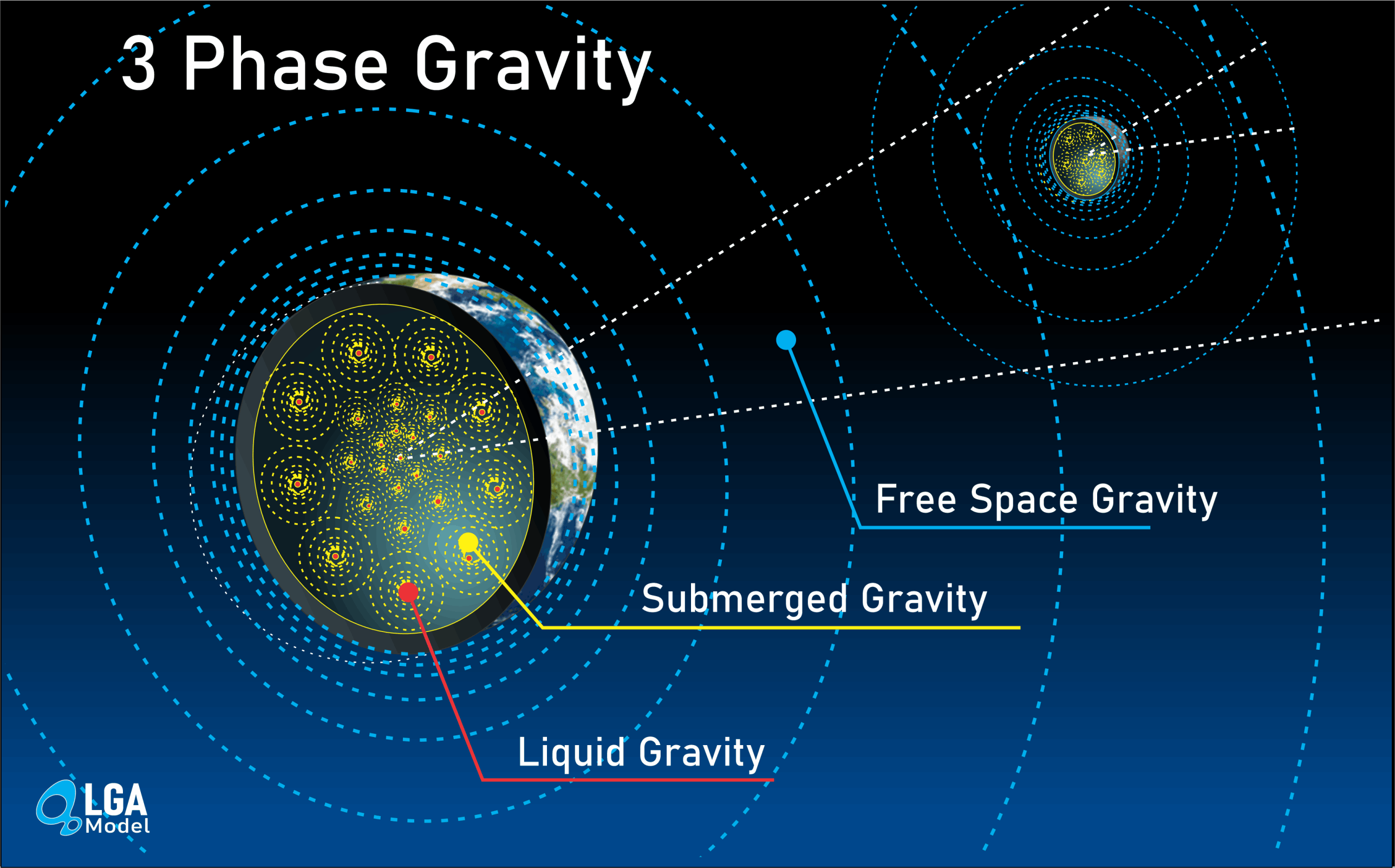
Gravity isn’t a simple, unbounded mathematical field — it behaves more like a cyclical, state‑changing process. The LGA model describes gravity in three phases:
Liquid Gravity: At the subatomic level, churning vortexes inside nucleons produce negative‑pressure gradients that condense an aether‑like fluid. This compressed, fluidic state contains quark eddies and vortex tubes that create strong, short‑range hydraulic forces (the strong nuclear interaction) and a residual component that seeds larger‑scale gravity.
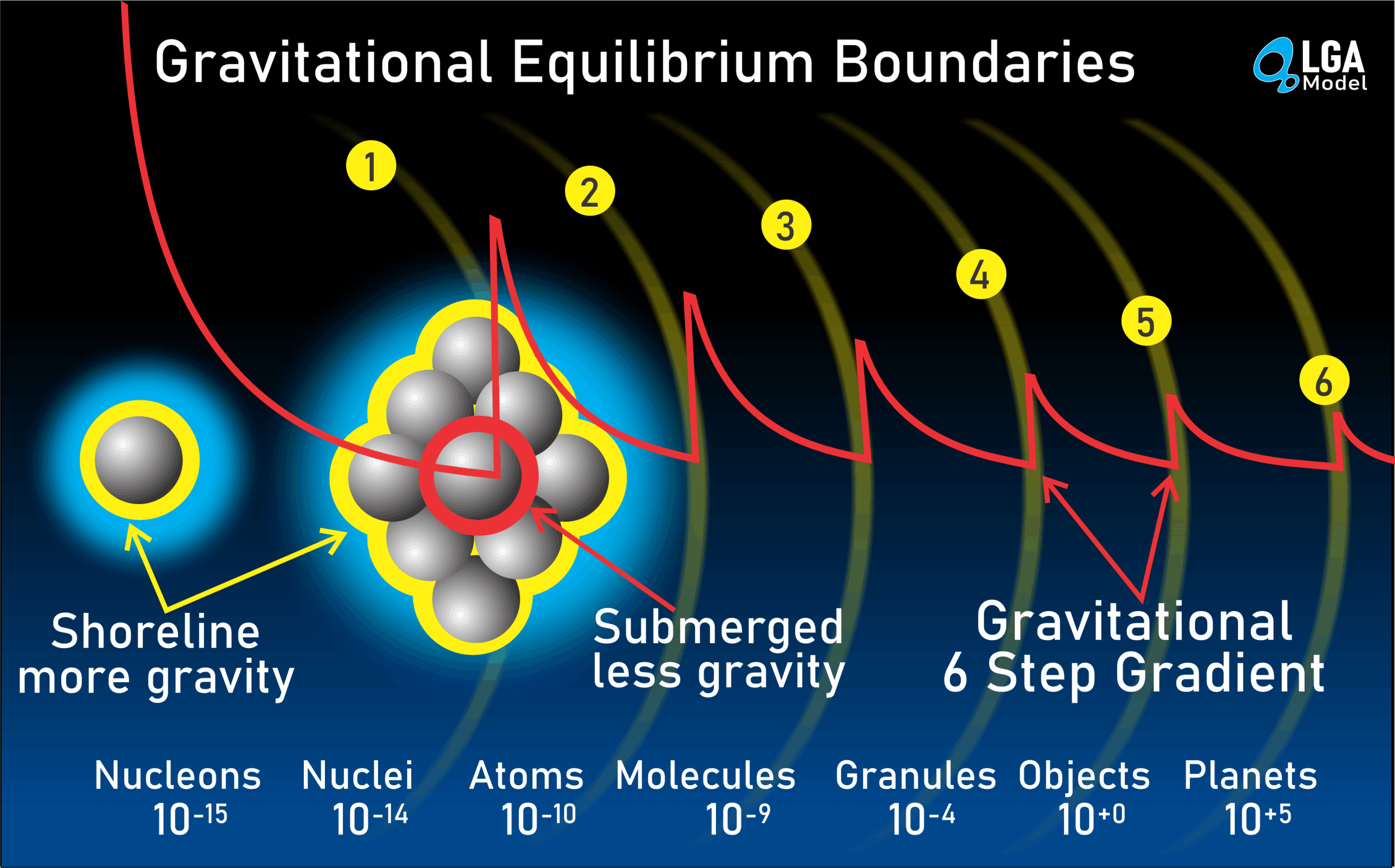
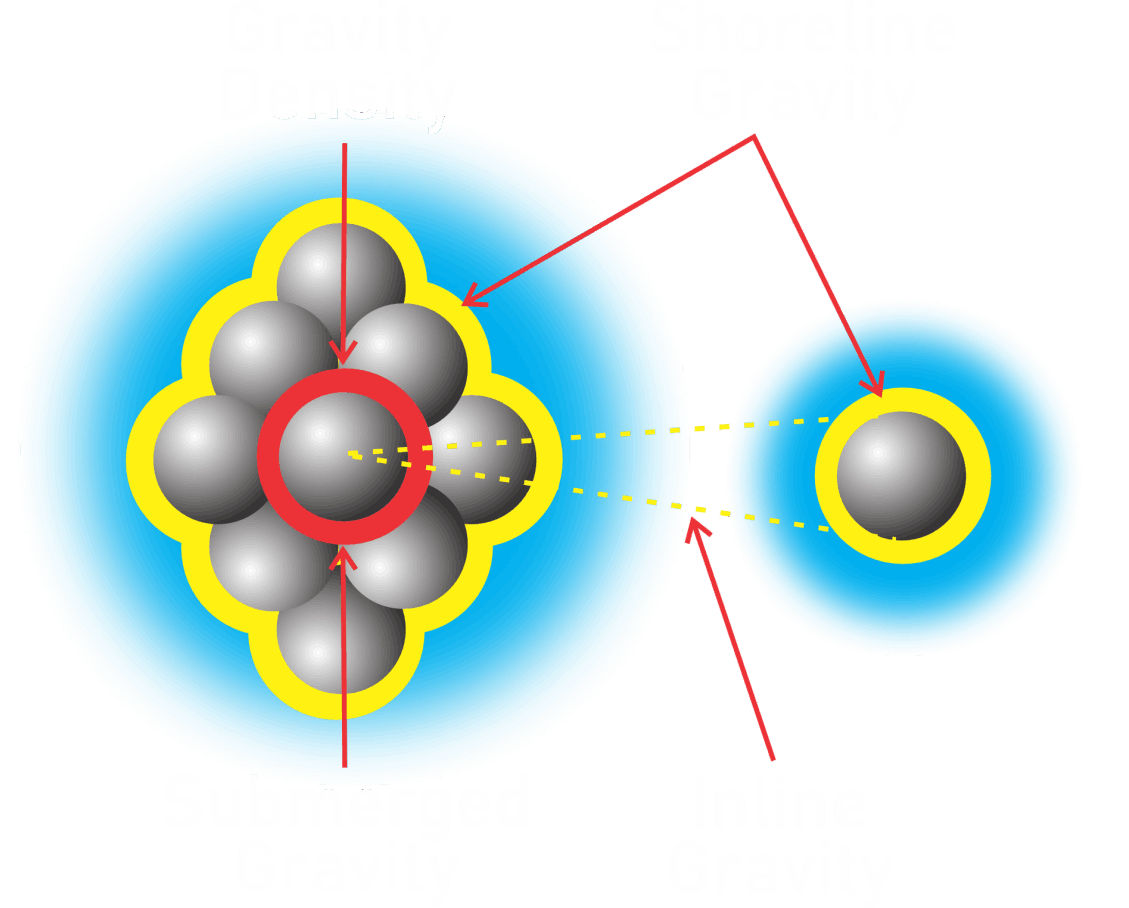
Submerged Gravity: As particles combine into nucleons, atoms, molecules and larger clusters, gravity organizes into discrete pressure‑equilibrium layers. Each layer has its own equilibrium boundary and pressure value independent of cluster size; growth of a cluster “submerges” additional gravitational elements beneath the shoreline, reducing their external coupling.
Free‑Space Gravity: When a body reaches its outer equilibrium boundary it behaves like the familiar gravity of planets, stars and galaxies. Even so, that observable field reflects only the outer layer’s coupling — much of the gravitational structure may remain stored or redirected within deeper layers.
This layered, phase‑based view recasts gravity as a stateful, distributed process rather than a single universal constant, producing testable predictions for how gravity behaves inside matter versus in free space.
Calculating Gravity's strength:
Introducing equilibrium boundaries and submerged gravity changes the calculation of gravitational strength at atomic scales. The LGA model proposes that the residual component of the strong interaction—arising from nucleon‑scale fluid dynamics and its localized, tidal behavior—is the physical origin of quantum gravitational coupling.
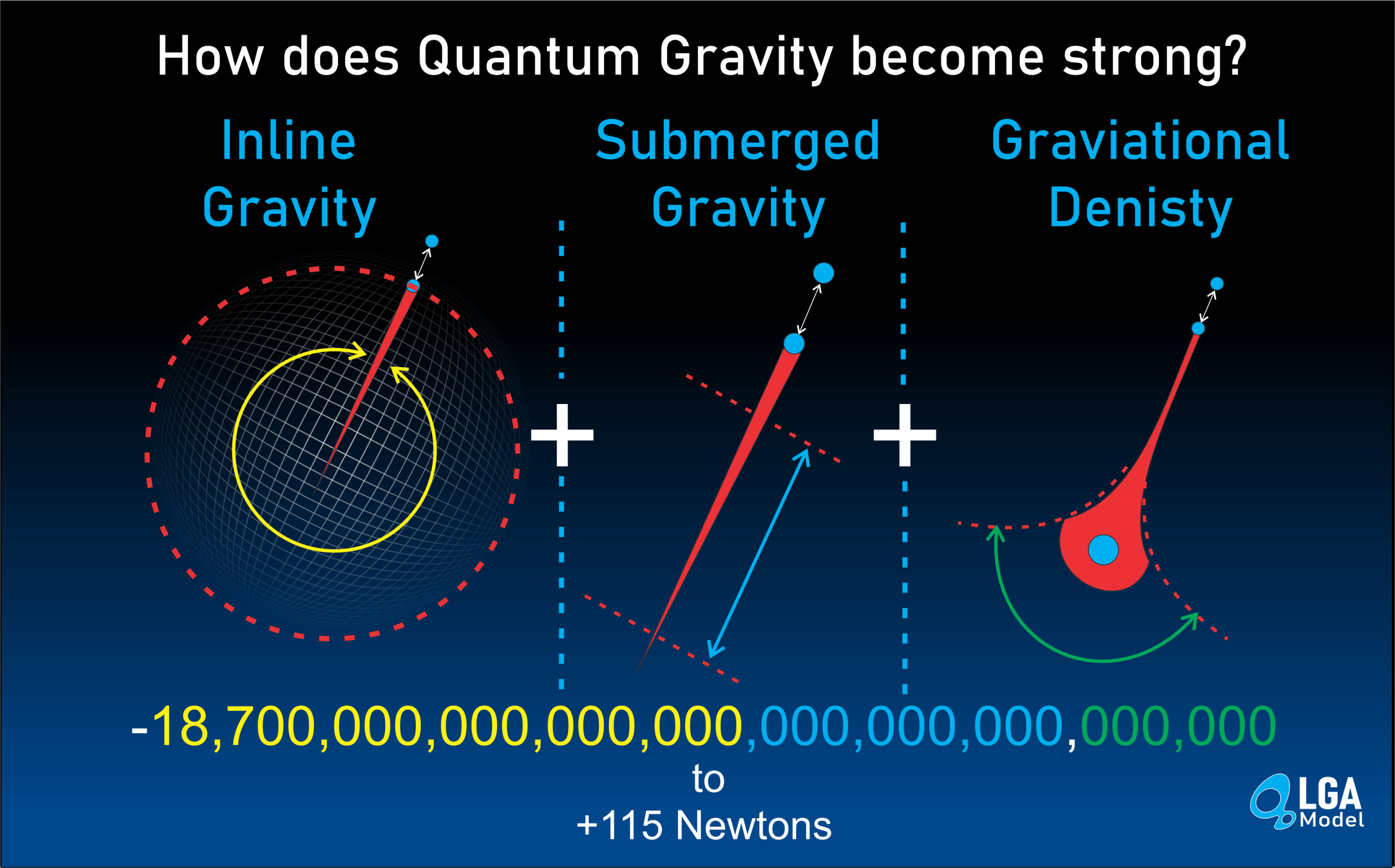
The scenically understood strength of quantum gravity is on the order of 1.87×10^−34 newtons, while the LGA model postulates that quantum gravity balances the positive force of a proton and would be about 115 newtons at nucleon scale. How do we account for this vast difference in estimates?
First, traditional gravity is calculated for free‑space objects and has been found accurate in that regime. The LGA model contends that gravity inside a body is not linear; several factors could account for the discrepancy.
Inline gravity:
Traditional gravity calculations consider whole bodies and their center‑to‑center separations. Inline gravity considers only the mass directly aligned along the line between two bodies, asserting that mass oriented in other directions has negligible effect on that line. If one does not divide by the full mass of the objects, the calculated gravitational strength can increase dramatically—potentially accounting for 10–17 orders of magnitude.
Submerged gravity:
As previously discussed, submerged gravity describes reduced coupling of deeply buried nucleons inside a nucleus. By extension, mass deeply buried within a body may decouple from its external gravitational influence.
Gravitational density:
In the LGA model, gravity is a density gradient that accumulates toward the centers of atoms, bodies, and galaxies. Time dilation caused by stronger gravity is well known; LGA further suggests that increasing density amplifies gravitational strength nonlinearly. Supporting evidence would include relativistic motion of standing‑wave nucleon features (e.g., apparent motion at a significant fraction of c). The model’s hydrodynamic picture of gravity could thus reconcile the weakness of conventional quantum‑gravity estimates with a much stronger effective quantum gravity at short scales.
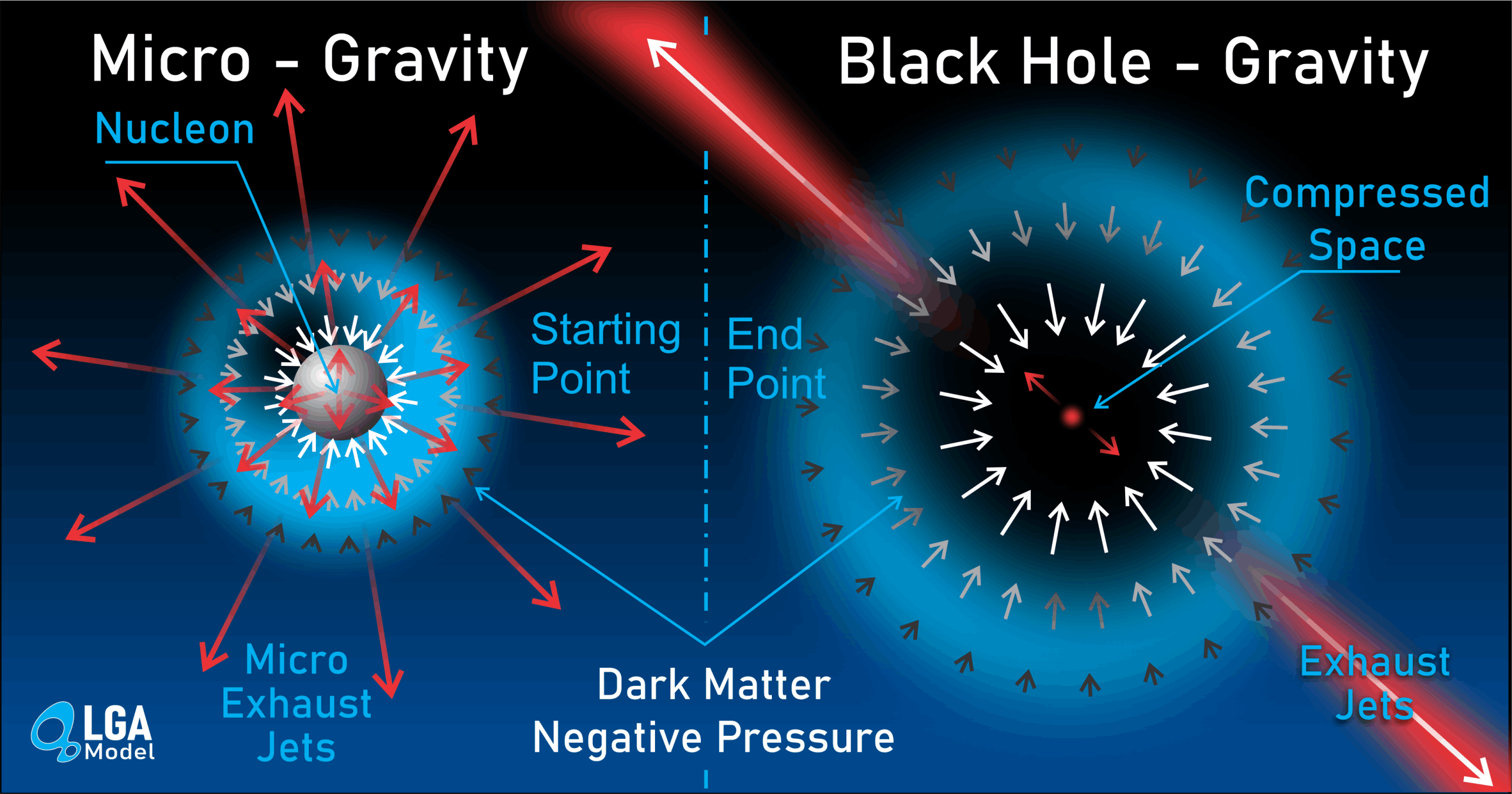
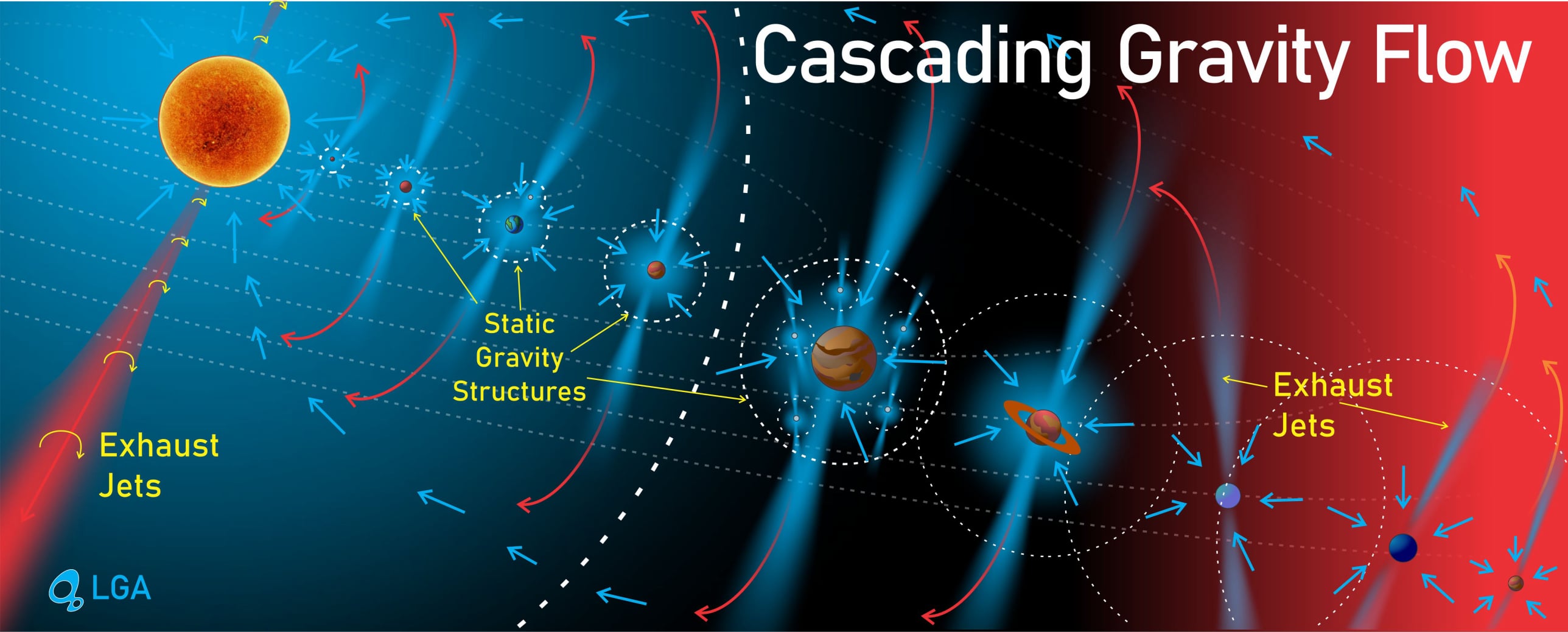
Gravity begins with energetic standing waves inside nucleons, churning a droplet of highly compressed aether‑like condensate. Vortex motion in these droplets creates a negative‑pressure gradient in the surrounding medium that draws nucleons into tight clusters. Surplus pressure is forced toward each cluster’s center and escapes as fine, filamentary strands. Those filaments lose pressure and density as they extend outward until they reach an equilibrium layer, where their residual negative pressure feeds the next gradient. The process repeats through submerged‑matter layers and again at the free‑space scale.
These layered gravitational structures form to natural limits determined by their equilibrium boundaries, producing characteristic ratios in the makeup of stars and planets. According to LGA, when a solar system’s residual gravitational pressure accumulates in galactic space it becomes what we observe as dark matter; the buildup toward galactic centers can compress into concentrated collision zones. The spectacular jets seen near black holes are, in this picture, streams of highly compressed condensate expelled past a galaxy’s equilibrium boundary.
Key points — LGA summary
-Gravity is an emergent pressure field that creates force gradients.
-Gravitational pressure accumulates slowly around bodies until an equilibrium boundary is reached.
-Dark matter corresponds to excess gravitational pressure accumulated in galactic space.
-Black holes are collision/convergence points of concentrated galactic gravitational pressure.
-Astrophysical jets are exhaust streams of compressed condensate expelled beyond galactic boundaries.
Gravity can form multiple equilibrium boundaries inside a body. Starting with individual nucleons that act as distinct gravitational units, but when they sit close together their fields merge into a shared shoreline with a common equilibrium pressure. That same layering appears at larger scales: Earth’s observable gravity is set at its outer equilibrium boundary, and as you move away those equilibrium layers space out until you meet the Moon’s or Sun’s boundary. This nested, repeating structure — a cascade of equilibria from nucleons up to planets and stars — implies gravity is not an unbounded, universal field but organized into discrete coupled layers. If gravity were visible, you’d see streams flowing from moons and planets into their parent bodies, ultimately cascading into the Sun.
Gravitational Myth 1 — Universal Attraction:
Newton’s inverse-square law implies every object attracts every other, yet most calculations treat only two-body interactions. The Liquid Gravity Atomic (LGA) model proposes that an object’s effective gravitational range terminates at an equilibrium distance. This helps explain why heavier atoms require extra neutrons to balance protons: each nucleon behaves as a distinct gravitational source with a nearer equilibrium when embedded in a larger nucleus.
Gravitational Myth 2 — Propagation speed of gravity:
Einstein’s theory and LIGO detections link gravitational waves to light-speed propagation, yet apparent near-instantaneous interactions remain debated. The Liquid Gravity Atomic (LGA) model suggests gravity is a quasi-static field produced by negative pressure in a pervasive medium; this medium’s large-scale gravitational structures move with their masses, while wave-like distortions travel at the speed of light. That distinction reconciles observed wave speeds with effectively immediate gravitational coupling
Gravitational Myth 3 — Gravity radiates outward like sunlight:
While photons stream outward from stars, gravity may behave differently. The Liquid Gravity Atomic (LGA) model posits that once an object’s equilibrium boundary is reached, excess gravitational influence is driven toward the center, compressed, and released as fine filamentary streams or polar exhaust jets capable of crossing equilibrium limits and linking adjacent gravitational wells.
Have some feedback or just want to say hi? Drop us a line!
at info@liquidgravity.nz