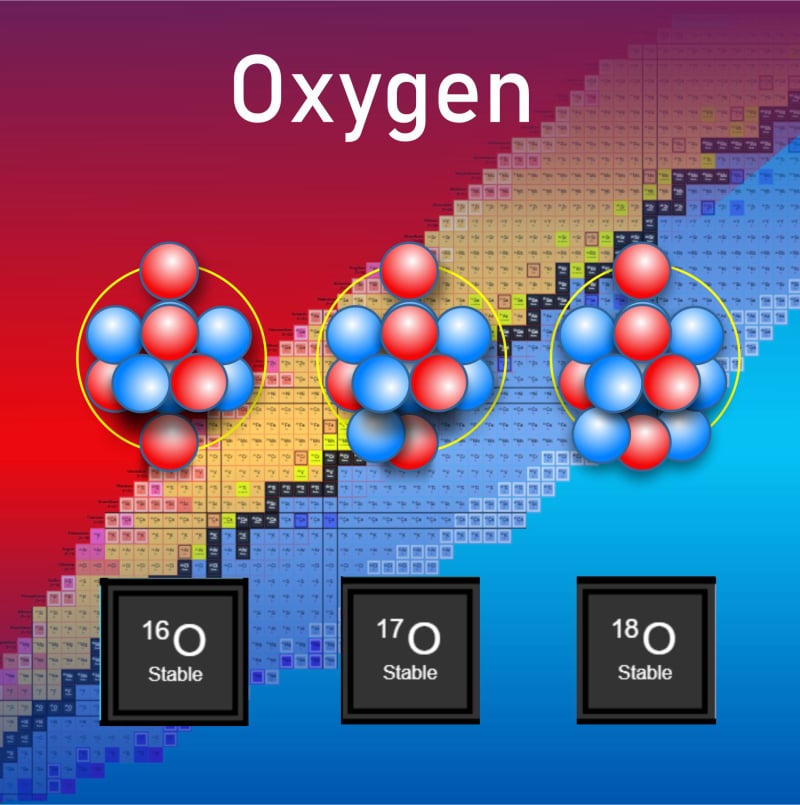
Oxygen
LGA Model
6 key properties govern the structure and binding energy of a nucleus. Understanding these will help science explore the hidden behavior of atoms and lead to new discoveries.
6 key properties govern the structure and binding energy of a nucleus. Understanding these will help science explore the hidden behavior of atoms and lead to new discoveries.
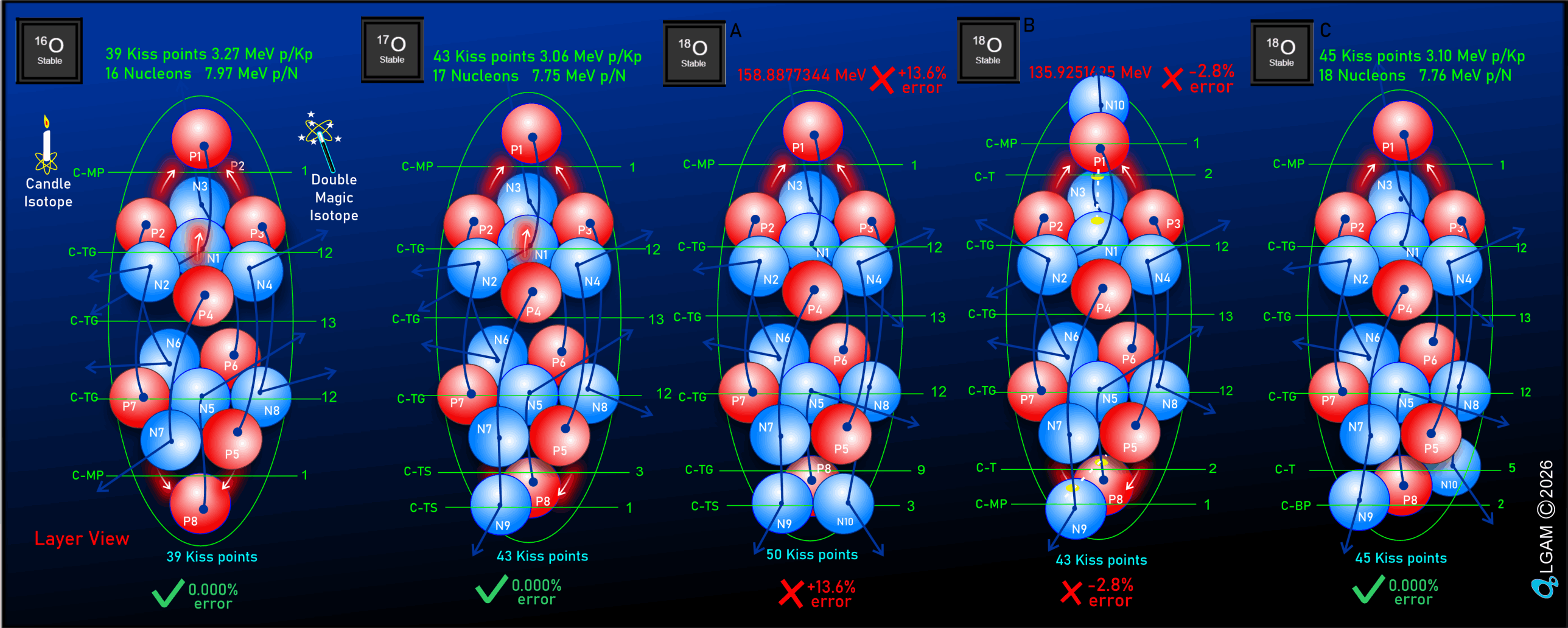
Oxygen isotopes 16–18 have been modeled from binding data by applying the principles of the Liquid Gravity Atomic (LGA) model (see the step-by-step methodology here).
By utilizing empirical measurement data to guide the structural construction of each isotope, this method reveals their precise geometric configurations. Evaluating these structures side-by-side ensures consistency across the entire isotope family. The resulting models provide a highly plausible visualization of each isotope's structure, offering structural explanations for their unique physical properties.
Results:
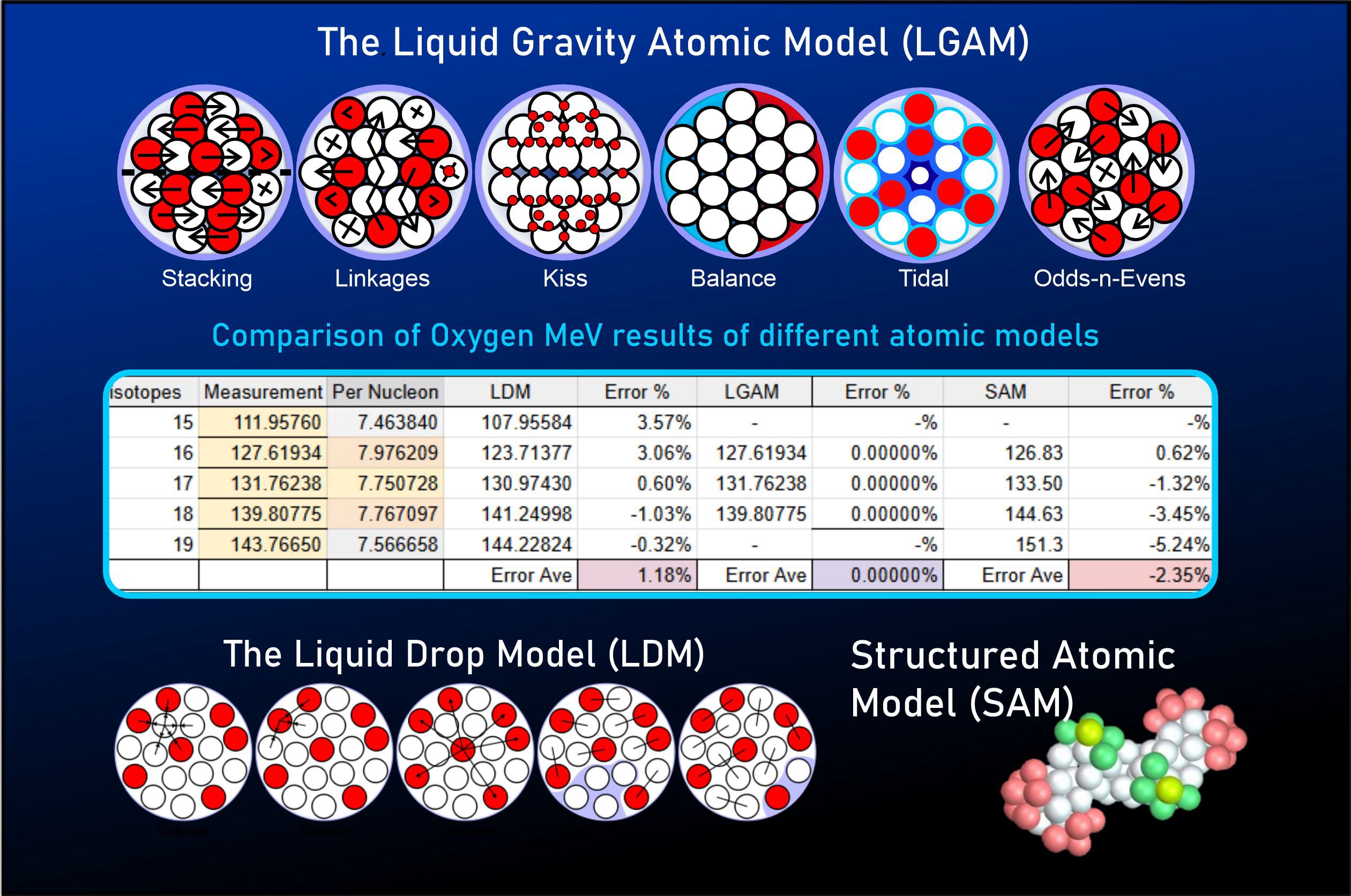
As summarized below, the results speak for themselves—demonstrating a staggering increase in predictive accuracy compared to conventional frameworks.
Conclusion:
The LGA model improves structural binding accuracy for Oxygen isotopes 16–18 by 5.5 orders of magnitude compared to the traditional Liquid Drop Model (LDM).
Oxygen Models under the LGA Method
Using the Local Gravity Architecture (LGA) model, we have mapped three isotopes of oxygen.
Traditionally, Oxygen-16 is celebrated in mainstream physics as a "double magic" isotope because it possesses 8 protons and 8 neutrons. According to the standard Shell Model, this combination represents a fully occupied energy level, producing a highly stable nucleus with an exceptionally high binding energy.
While that explanation sounds plausible, calculations using the Liquid Drop Model (modified with Shell Model magic numbers) still result in an error rate of 3.06%. Simply put: the Shell Model doesn't quite work.
So, what solution does the LGA Model offer for magic numbers?
By modeling the nucleus using the rules of the LGAM method, we gain a much deeper structural understanding.
Oxygen (16)
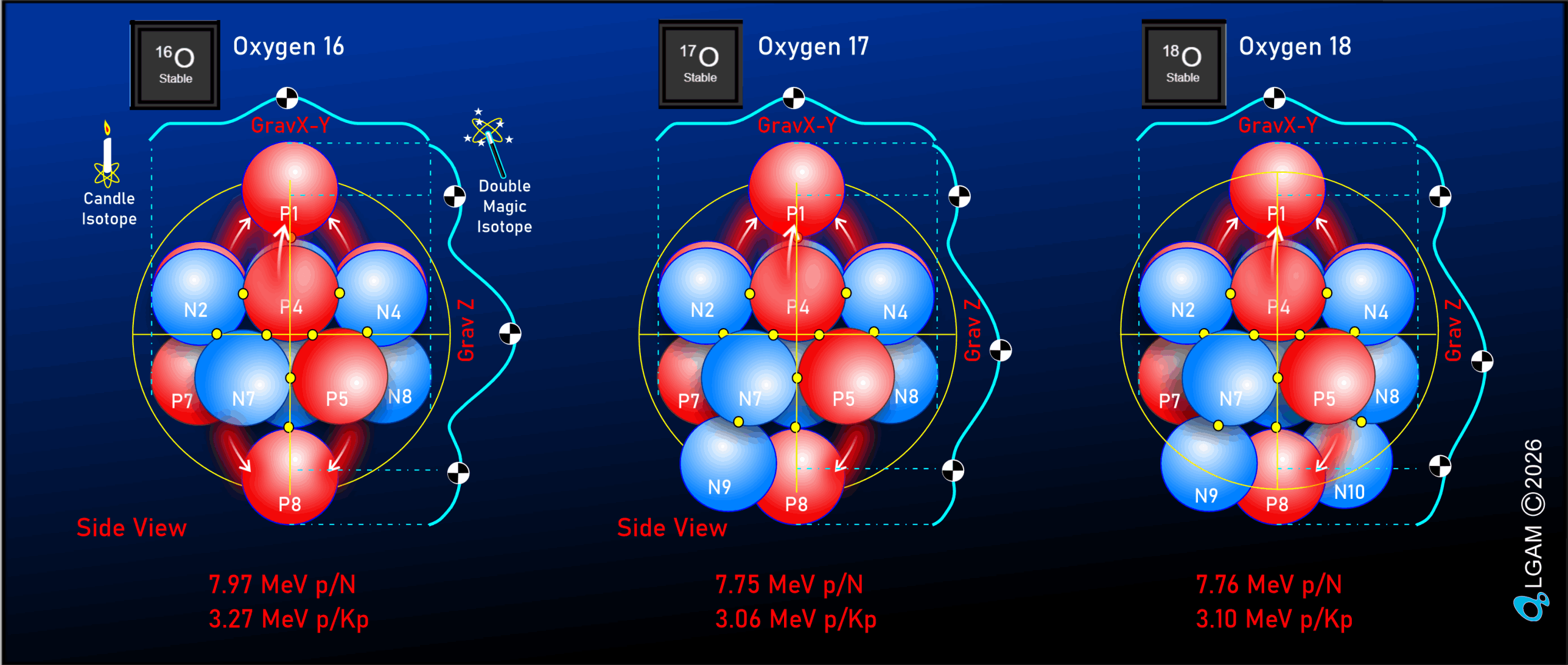
After testing several configurations, we settled on the structural model shown below. There is a noticeable difference in its binding energy compared to other isotopes, indicating a unique structural anomaly. While most oxygen isotope models share a similar core, the differences become starkly apparent along the bottom layer.
Cresting vs. Nesting Connections:
When studying the top and bottom layers of Oxygen 16, we observe a cresting formation rather than typical nesting.
-A stable connection usually requires at least a 3-point nesting configuration.
-A crest connection occurs when two nucleons meet along a crest line at just a single or double point.
The Role of Competing Forces:
These cresting connections are caused by surrounding electromagnetic forces repelling the nucleons, while just enough localized gravitational force remains to maintain a point of contact. In Oxygen (16), the protons on the top and bottom layers are perfectly balanced on a single "kiss point."
Concentrated Binding Energy:
The gravity distribution in Oxygen (16) is separated into three distinct clumps. This concentrates the strongest gravitational forces directly around the central kiss points, resulting in a spike in binding energy.
In other oxygen isotopes, additional nucleons fill into the top and bottom layers. This causes the gravitational concentration to spread more evenly across the entire structure, slightly reducing the overall relative binding energy per nucleon.
Oxygen (17)
In this isotope, the extra neutron is perched off-center on the side of the atom, rather than being centered as one might expect. This occurs for two primary reasons:
Dominant Electromagnetic Forces:
Gravitational strength diminishes along the outer edges of the structure, allowing electromagnetic forces to become the dominant driver.
Electromagnetic Coupling: The extra nucleon couples to an existing nucleon chain. It experiences a stronger electromagnetic force circuiting from a specific 1.69 MeV proton, which complements the gravitational attraction. Meanwhile, that central proton remains anchored by the mutual repulsion of the three surrounding protons.
Validation:
Force-counting calculations using the LGAM method confirm that this specific asymmetrical configuration perfectly aligns with experimentally measured binding data.
Oxygen (18)
A repeating structural pattern occurs here: the next added neutron occupies the exact opposite side of the structure to restore symmetrical balance.
Testing alternative Models:
To verify this layout, we constructed and tested several alternative models by placing the extra neutrons in different locations. However, the resulting data failed to match reality. The LGAM method confirms that only this symmetrical, side-perched configuration aligns with true, measured binding data.
Conclusion:
These oxygen models serve as an excellent case study of how the competing dynamics of localized gravity and electromagnetic repulsion physically shape atomic nuclei.
The LGA Model vs. Mainstream Nuclear Physics
Mainstream science typically relies on a combination of the Liquid Drop Model (LDM) and the Shell Model to predict the binding energy of isotopes. While these frameworks are useful for broad generalizations, they suffer from a major limitation: they produce average macro-results rather than identifying the precise binding data of individual nucleons. Using existing quantum and statistical theories, attempting to calculate individual nucleon binding data remains computationally over-complex and impractical.
In contrast, the Liquid Gravity Atomic (LGA) Model introduces a purely structural approach governed by the fundamental rules of electromagnetic attraction/repulsion and localized gravitational forces.
The "Kiss Point" Methodology
Once an LGA model is physically or computationally constructed, the "Kiss Points"—the exact spatial coordinates where nucleons physically contact one another—are cataloged and their geometric relationships identified.
Granular Precision:
By mapping these precise locations, the unique energy value of each individual kiss point is calculated.
Summation to Empirical Data:
These individual values are then summed together to compare against real-world empirical measurements.
Structural Lattices:
This method produces a highly accurate map of all contact points, providing a structural lattice of known values that offers unprecedented insight into the specific geometric strengths or weaknesses of a nuclear structure.
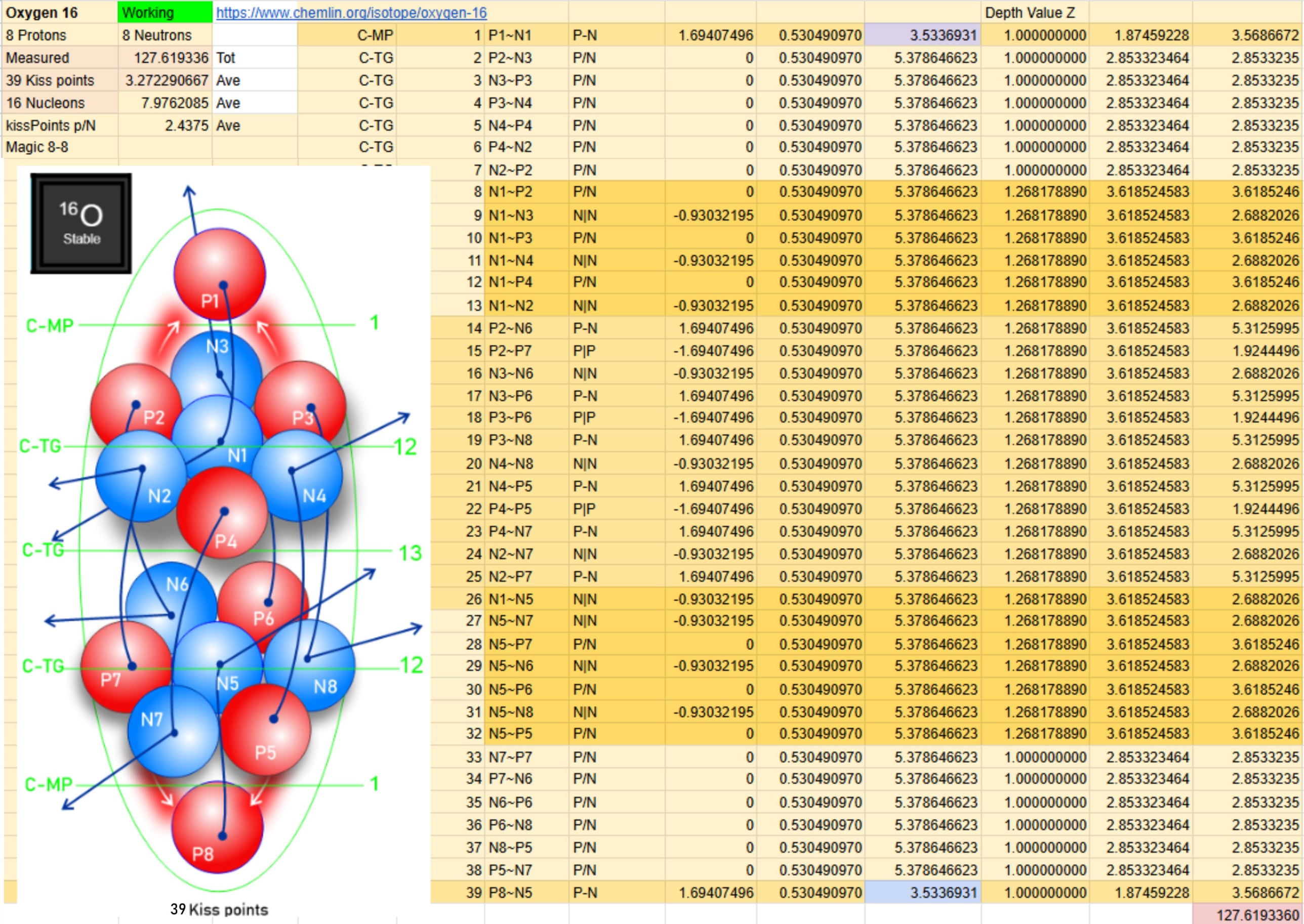
Predictive Accuracy: Oxygen-(16)
To demonstrate the accuracy of the LGAM method, we can look at the calculation profiles for the Oxygen-16 isotope. While the standard Liquid Drop Model (even when modified with Shell Model magic numbers) struggles with a 3.06% error rate, the LGA Model maps the structure with an astonishing 0.0001% error rate.