Beryllium

LGA Model

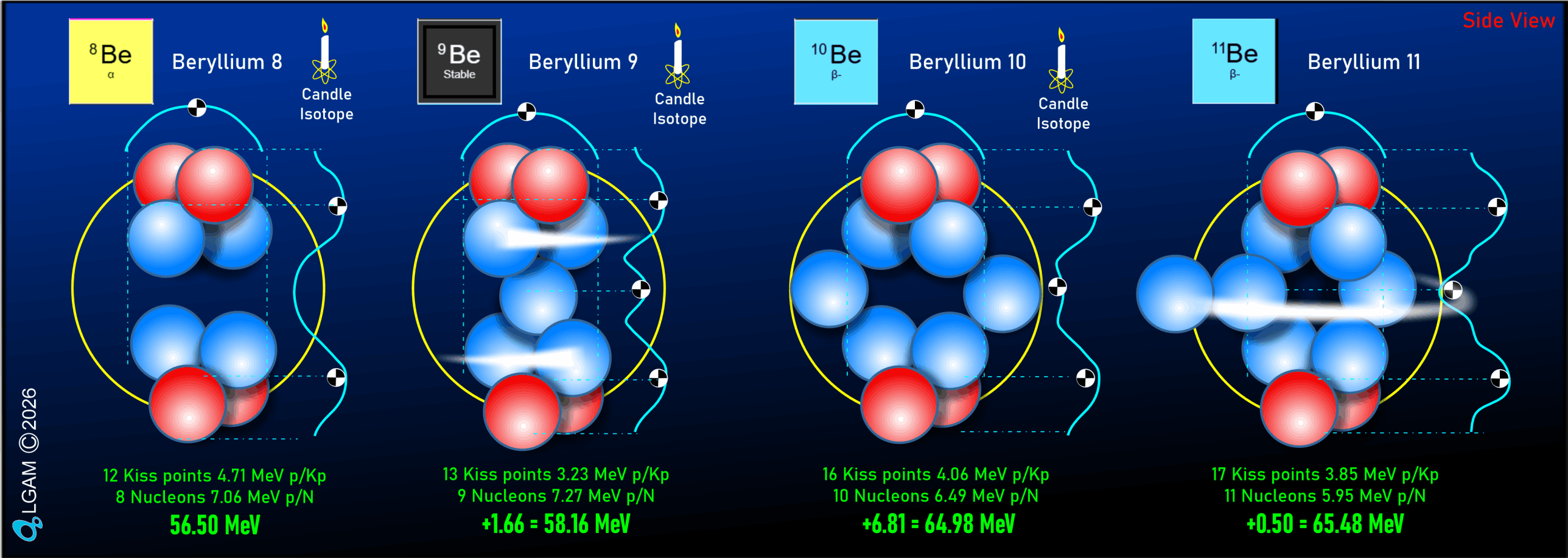
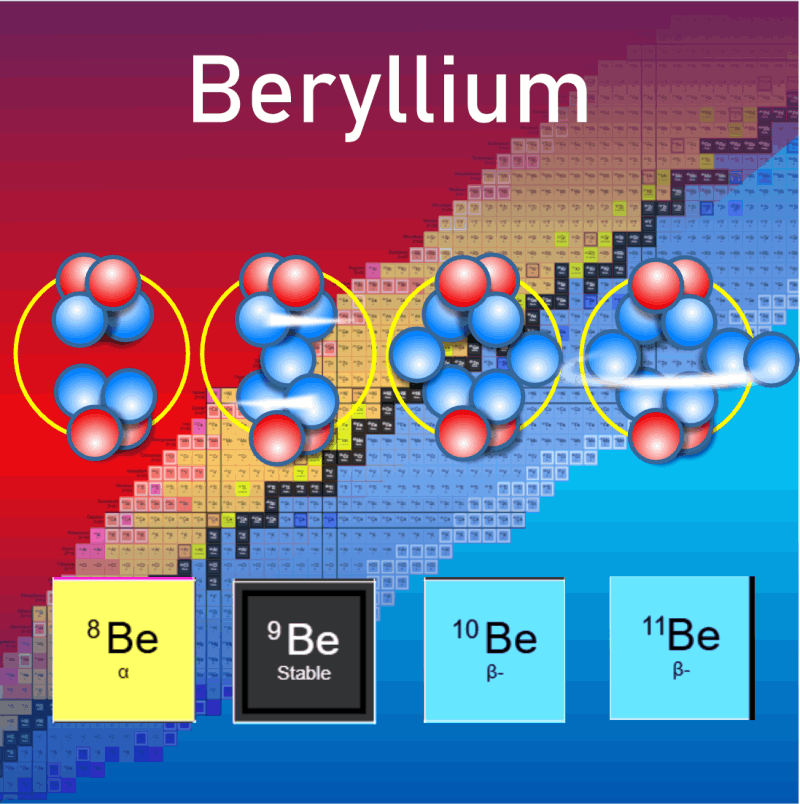
Beryllium possesses an acrobatic structure that spins and hovers in defiance of gravity. Specifically, Beryllium-9 exhibits a distinct dumbbell shape while Beryllium-11 is recognized as a halo isotope with an orbiting neutron. Under the LGA model, these exotic properties beautifully demonstrate the balancing act between electromagnetism, multi-body gravity and centrifugal forces.

Beryllium Isotopes

Beryllium 8-11

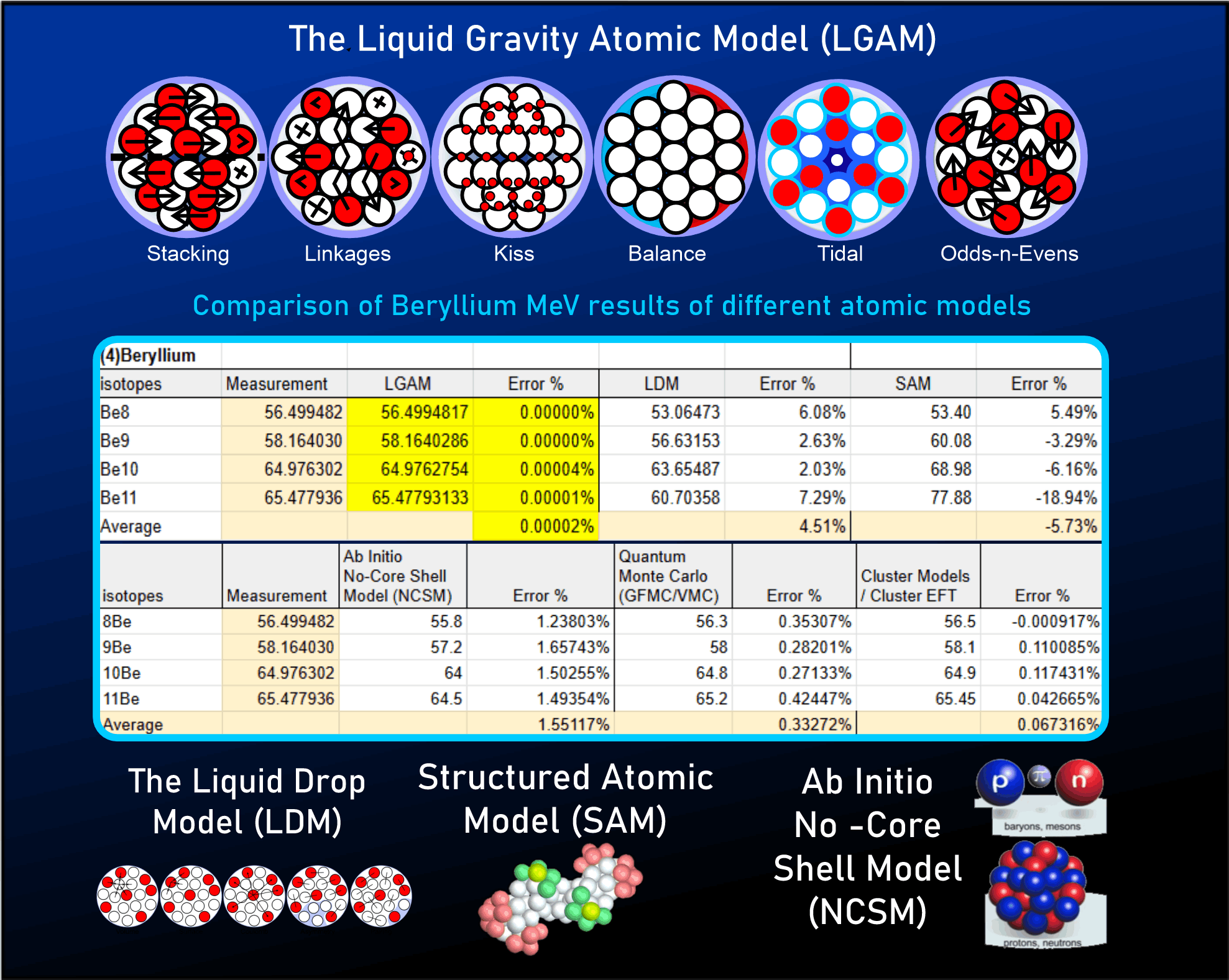
 Beryllium perfectly demonstrates why generic formulas fail to accurately determine nuclear binding data, particularly when a mathematical model contradicts physical reality. Beryllium isotopes can form dumbbell shapes, exhibit orbiting halo neutrons, and even feature a hollow center—the exact opposite of a uniform liquid drop. Because of these geometric anomalies, the traditional Liquid Drop Model (even with Nuclear Shell Model modifications) carries an error rate of 2% to 7%.

The Liquid Gravity Atomic Model (LGAM) overcomes this by shifting the basis of the calculation, bringing the error rate down below 0.0002%. Instead of a generic formula, LGAM uses "candle isotopes" as baseline empirical anchors to resolve neighboring structures. For the Beryllium isotopes highlighted here, the alpha particle acts as the core candle isotope, with Hydrogen-2 and Hydrogen-3 mapping the unique, dynamic mechanics of this element.

Conclusion:
The LGA model significantly improves structural binding accuracy for Beryllium isotopes 8–11 relative to the traditional Liquid Drop Model (LDM) and the SAM model. Furthermore, while sophisticated quantum models achieve high precision for light isotopes, they hit a computational wall when scaling to heavier elements.


Beryllium Atomic Model comparison

Beryllium 8-9 Models

Beryllium-8 (8Be) Modeled Under the LGA Method
The formation of the Beryllium nucleus reveals a distinct alpha-particle cluster structure. Two independent Helium-4 particles possess a combined binding energy of roughly 56.6 MeV, while Beryllium-8 sits just below that at around 56.5 MeV. This slight energy deficit is a critical piece of the puzzle.

Beryllium-8 (Unstable Half Life 8.19 * 10-17 seconds.)
 +28.29MeV: Is the top Alpha particle (Candle Isotope)
  -0.09MeV: Net repulsion of each cluster Like-Like charges
  +28.29MeV: Is the top Alpha particle (Candle Isotope)


Accounting for distance and Coulomb dynamics reveals repulsive forces acting across both protons and neutrons. This collective repulsion is ultimately what drives the two alpha structures apart, triggering alpha decay. This phenomenon highlights a key contradiction in mainstream physics:

 Q: If the Liquid Drop Model is correct in assuming nucleons are in a perpetual, random jumbling state, why would they reliably segregate into independent alpha particles?

The LGAM resolves this by modeling a structured system of charges and gravity. Gravity provides the foundational attraction, while competing attractive and repulsive charges organize the nucleons into a rigid hierarchy. For (8Be), this geometric arrangement divides the gravitational mass into two distinct clusters, with proton-on-proton repulsion (and lesser neutron contributions) providing the final outward push. This delicate balance of repulsion defines the mechanics of the other Beryllium isotope models.


Beryllium-9 Modeled Under the LGA Method
Unsurprisingly, there is only one stable Beryllium isotope, and that is Beryllium-9. Described as a dumbbell with a narrow waist and two distinct alpha clumps, the geometry of this isotope is unusual. In addition to its shape, the two alpha particles exhibit opposing rotations, functioning much like an engine counter-rotating around a central shaft in opposite directions.

The LGAM explains these behaviors through its structural arrangement. The position of the additional neutron is due to all the other neutrons distributing their respective proton charges, which creates four positive Proton-Neutron-Neutron chain connections. Because the charge pulses from opposite sides of each conducting neutron, the connecting neutron grabs the next charge in the sequence. This causes the two opposite alpha particles to spin with opposite torque.

Beryllium-9 (Stable)
   +56.5 MeV: Beryllium-8 (Candle Isotope) provides the base structure. 
This central nucleon is held in place by an interesting combination of other forces:
   +1.69 MeV: One single positive charge connection
   -0.22 MeV: A small amount of centrifugal force
   +0.5 MeV: Gravity based on the Hydrogen-2 (candle isotope)
   -0.3 MeV: Net repulsion when the charge is out of sequence 


When you add these forces together, they create a net increase of plus 1.67 MeV. Combining this with the Beryllium-8 baseline of 56.5 MeV delivers the total binding energy of 58.17 MeV, matching the experimental total of around 58.2 MeV.

You might argue that because the neutron touches 4 other neutrons, its gravitational connection should increase accordingly. However, because the charge moves in a sequence, it is only ever connected to one of the neutrons at a time. The rest of the time it experiences a net repulsion of minus 0.3 MeV.

With all of that going on, Beryllium-9 remains stable.


Beryllium Models

Beryllium 10 Models

Redefining Beryllium-10: Does the LGA Model Explain the Nuclear Anomalies?

When analyzing the range of beryllium isotopes, nuclear physicists face a fascinating anomaly: a disproportionately high spike in extra binding energy compared to neighboring isotopes.

In standard models, we usually assume a higher degree of nucleon coupling takes place to increase overall binding energy. Other isotopes in this range exhibit minimal connections, resulting in negligible additional binding energy. So, what exactly is happening inside Beryllium-10 (10Be) to cause this massive energy jump?

Two competing models offer starkly different explanations.

The Contenders: The Molecular Model vs. The LGA Model

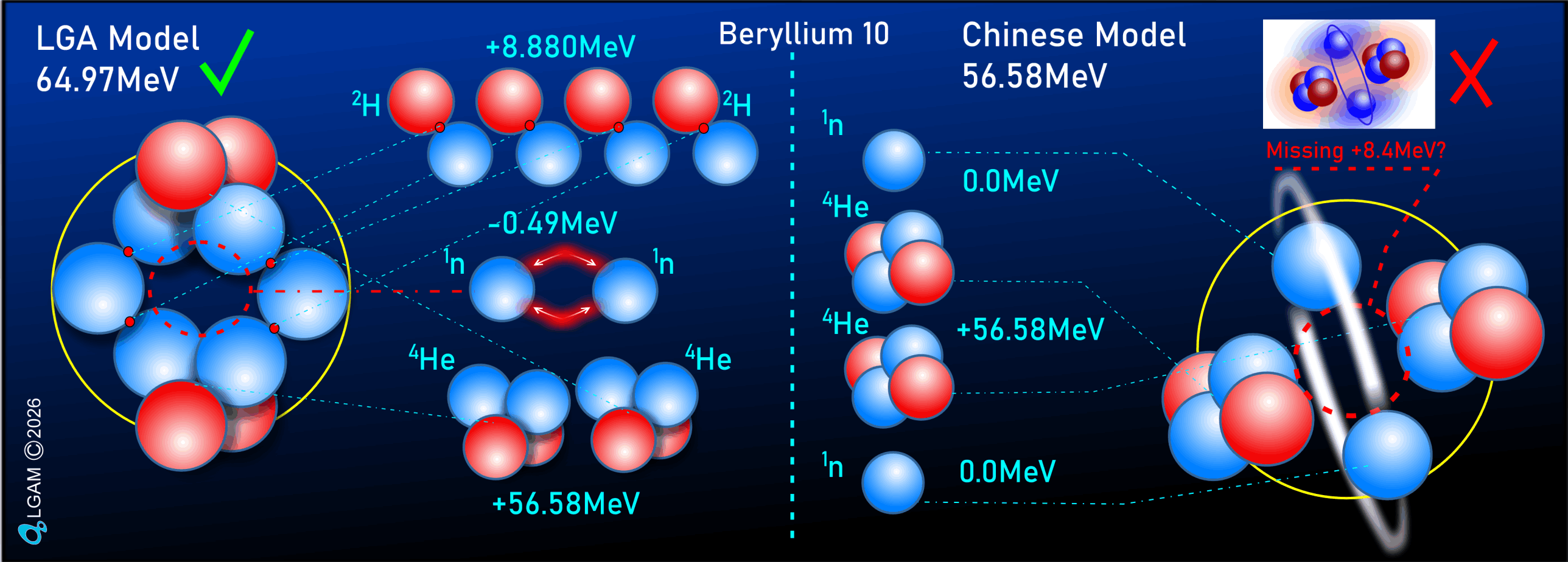
Recently, the Institute of Modern Physics in China probed the structure of 10Be. Their findings suggested a highly dynamic molecular structure: two alpha particles separated by two valence neutrons orbiting around the core. (Link to paper)

When we evaluate this using the Liquid Gravity Atomic (LGA) Model, we find a few striking similarities—but some fundamental, structural differences.

The Similarities:

-The distinct separation of two alpha particles.

-The matching general location of the two valence neutrons.

-The clear formation of a molecular-like nuclear structure.

The Differences:

-The LGA Model features a more static, rigid structure. Its two valence neutrons are firmly attached, binding the components into a single nucleus with a hollow center.

-The Chinese Model proposes a dynamic, fluid system featuring an orbiting pair of valence neutrons that are completely detached from one another, effectively forming four separate elements.

Testing the Models: The Energy Discrepancy

How do we determine which model is more physically viable? We can test them by breaking down their individual components and applying known nuclear binding energy values.

Testing the Chinese Model
If we calculate the baseline energies of the isolated components suggested by the Chinese model, the math falls short:

+28.29 MeV: 4He (Alpha particle)
+0.00 MeV: 1n (Single neutron)
+28.29 MeV: 4He (Alpha particle)
+56.58 MeV Total


The actual measured binding energy of 10Be is 64.97 MeV. This leaves the Chinese model short by 8.39 MeV of missing energy.

Testing the LGA Model
Conversely, when we break down the LGA model using established candle isotopes, the values align perfectly with the actual experimental total:


+28.29 MeV: 4He (Alpha particle candle isotope)
+2.22 MeV: 2H (Deuterium candle isotope)
-0.49 MeV: (Accounted loss due to neutron-neutron repulsion)
+2.22 MeV: 2H (Deuterium candle isotope)
+28.29 MeV: 4He (Alpha particle candle isotope)
+64.97 MeV Total


Mechanical Stability: What Holds the Nucleus Together?

Beyond the clear discrepancy in binding energy, both models must answer a fundamental question: What mechanical forces are keeping this nucleus from flying apart?

In the Chinese model, there are no clearly defined connections holding the detached components together—a glaring issue given that separate, like-charged elements are known to naturally repel each other. Furthermore, it leaves an open question: Where do the two valence neutrons obtain the continuous energy required to orbit the nucleus?

The LGA model solves these mechanical paradoxes simultaneously:

Structural Integrity: The nucleus is held together primarily by the electromagnetic connections of its dual neutron chains. This robust link provides 10Be with its relatively stable, remarkably long half-life of 1.387 million years.

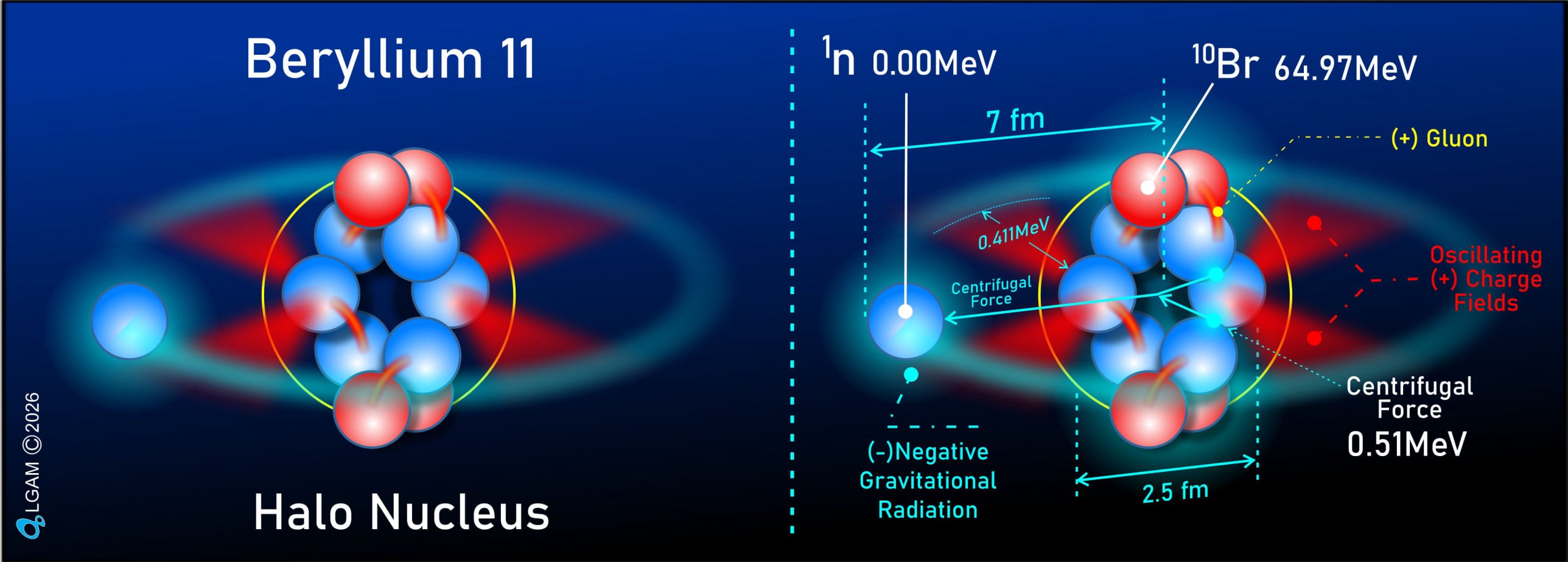
Dynamic Energy: While the LGA model generally describes movement via the oscillating distribution of positive charges—which can generate an orbiting neutron, as observed in Beryllium-11 (11Be)—the case of 10Be is different.

In 10Be, these charge oscillations are locked. The top and bottom alpha particles simultaneously charge the valence neutrons, locking them firmly into their structural position and accounting for the missing energy jump.
    

Beryllium 10 Model

Circuits

The Structural Evolution of Beryllium Isotopes: An Inside-Out Element

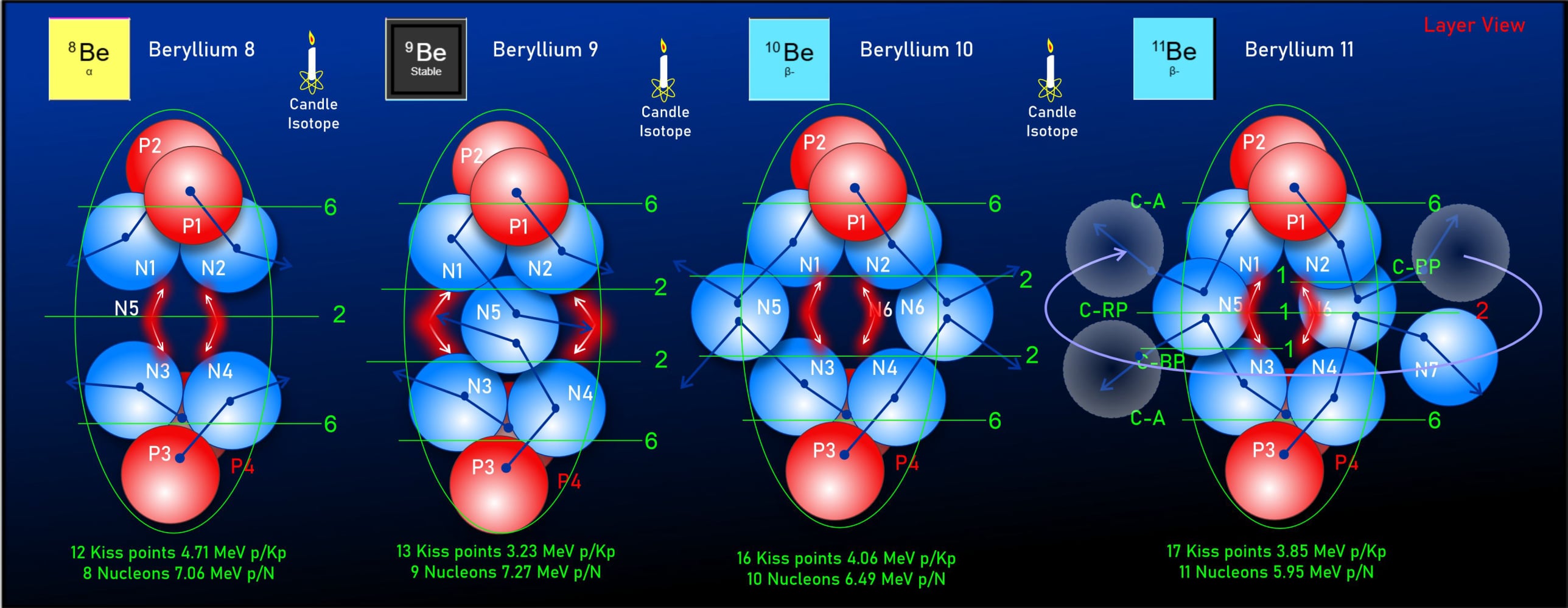
When we study the electrical chains of each beryllium isotope from 8Be to 11Be, we observe a definite progression of circuits colliding and then spreading outward. It is almost like watching an egg drop onto a mirror and witnessing the perfect symmetry of the impacting splatter pattern. This progression demonstrates how electrical circuits play a major role in the structural formation of atomic nuclei across all elements.

The primary mechanism behind this growth is that the end of each circuit provides a highly attractive connection point for any prospective new neutron. If this neutron is not clamped inward by the clustering strength of gravity, the electromagnetic chain extends outward to form valence neutrons or halo-nuclei structures.

Beryllium-11 (11Be) serves as an excellent example of these outward-branching circuits. It forms an orbital track for a single valence neutron, guided by oscillating charges distributed in a synchronized series of charge bursts that pull the neutron into a tight orbit. However, the rotation of this orbiting neutron introduces an additional force for the nucleus to contend with: centrifugal force. This force pulls at the electromagnetic link, weakening the connection and reducing its binding energy from 2.22 MeV to just 0.5 MeV.

While this entire sequence of isotopes appears unusual, it paints a clear picture of how isotopes grow and change shape. In the case of beryllium, the alpha particles have literally pulled the element apart. As a result, we are able to witness structural formations on full display that would normally work inwardly on most other elements, effectively revealing an inside-out element.


Beryllium Models Circuits

Formula

The LGA Model vs. Mainstream Nuclear Physics
Mainstream science typically relies on a combination of the Liquid Drop Model (LDM) and the Shell Model to predict the binding energy of isotopes. While these frameworks are useful for broad generalizations, they suffer from a major limitation: they produce average macro-results rather than identifying the precise binding data of individual nucleons. Using existing quantum and statistical theories, attempting to calculate individual nucleon binding data remains computationally over-complex and impractical.

In contrast, the Liquid Gravity Atomic (LGA) Model introduces a purely structural approach governed by the fundamental rules of electromagnetic attraction/repulsion and localized gravitational forces.

The "Kiss Point" Methodology
Once an LGA model is physically or computationally constructed, the "Kiss Points"—the exact spatial coordinates where nucleons physically contact one another—are cataloged and their geometric relationships identified.

Granular Precision:
By mapping these precise locations, the unique energy value of each individual kiss point is calculated.

Summation to Empirical Data:
These individual values are then summed together to compare against real-world empirical measurements.

Structural Lattices:
This method produces a highly accurate map of all contact points, providing a structural lattice of known values that offers unprecedented insight into the specific geometric strengths or weaknesses of a nuclear structure.

Predictive Accuracy: Beryllium-(11)
To demonstrate the accuracy of the LGAM method, we can look at the calculation profiles for the Beryllium 11 isotope. While the standard Liquid Drop Model (even when modified with Shell Model magic numbers) struggles with a 7.29% error rate, the LGA Model maps the structure with an astonishing 0.0001% error rate.


© 2026 Liquid Gravity Atomic Model