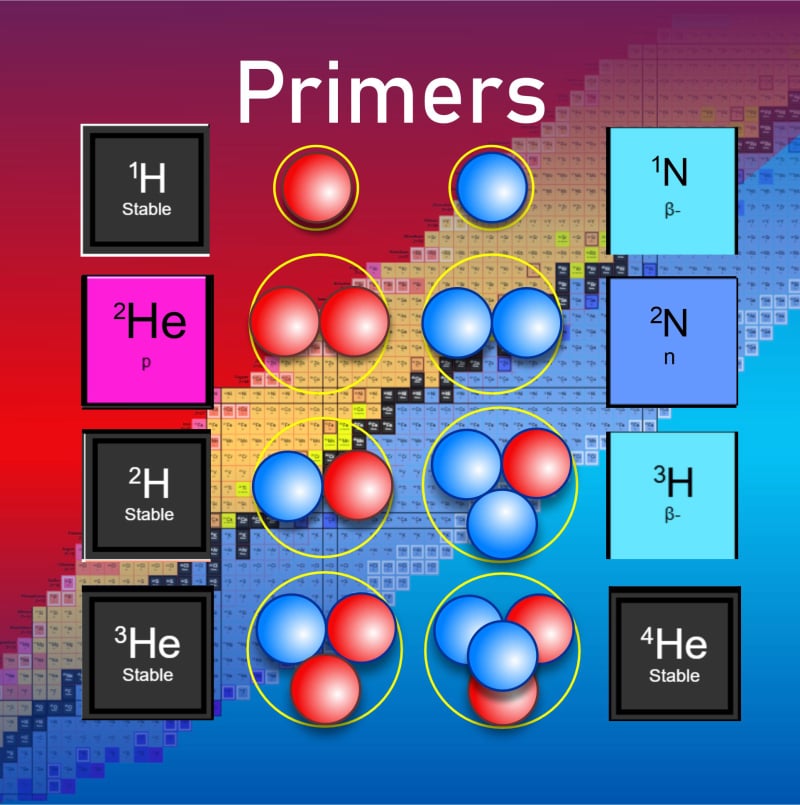
Protons and neutrons—including simple configurations like helium—serve as the core building blocks for the LGA model. Understanding their baseline relationships and properties allows us to scale these rules upward, decoding the structures of larger, more complex elements.
Single Proton
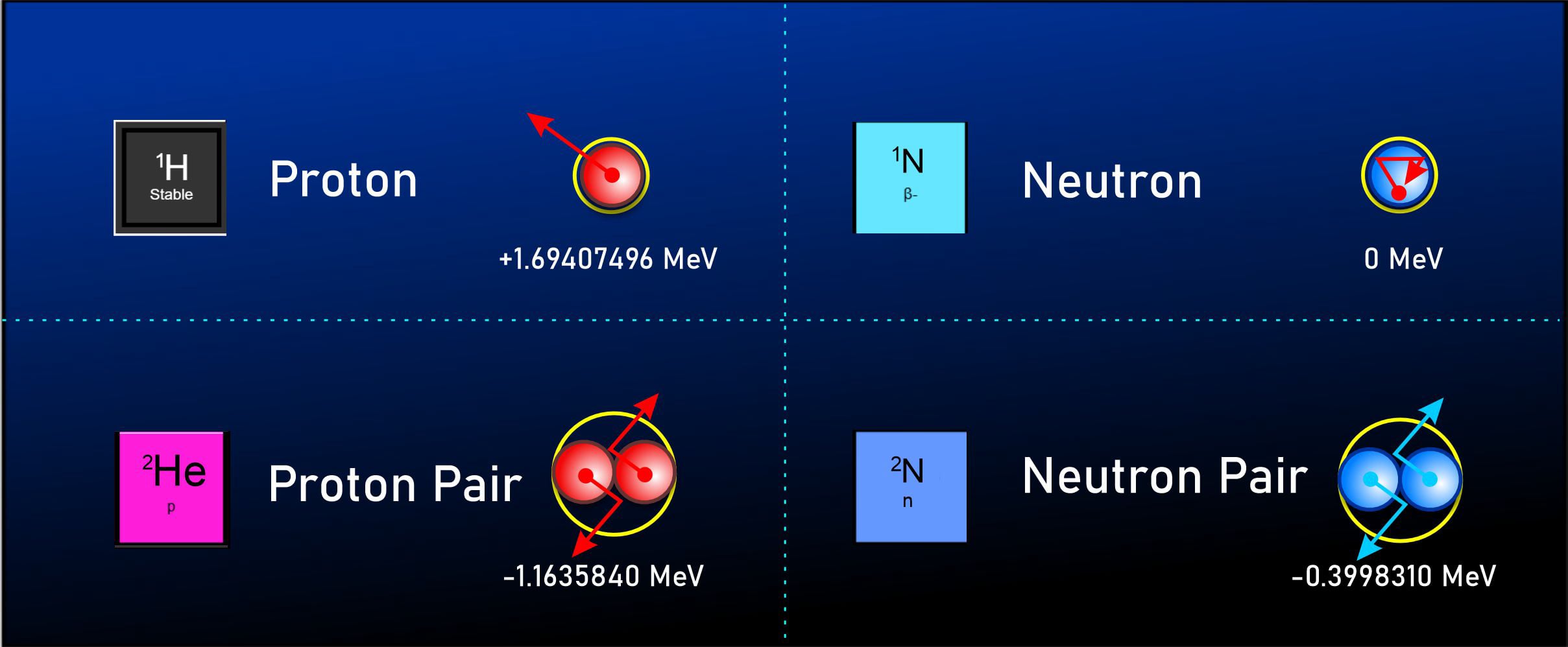
A proton on its own has a positive +1 charge, which equates to a value of +1.69407496 MeV. This is calculated using Coulomb's law based on the electrical attraction of opposite charges at a physical distance of 0.85 fm.
Proton Pair
A proton pair experiences a baseline repulsive force of -1.69407496 MeV at a distance of 0.85 fm, which is the boundary distance at which they physically make contact. Simultaneously, the pair shares a base gravitational attraction value of +0.53049097 MeV.
The combined net force between two protons is evaluated using the LGA baseline formula:
Charge + (Gravity × Tide Value) = MeV:
Kiss point 1 (P1~P2): -1.69407496 MeV + (0.53049097 MeV × 1) = -1.16358399 MeV
While an isolated, stable proton-proton pair cannot be directly evaluated via standard experimental measurements, this localized repulsive baseline is vital for calculating the energy distributions of heavier isotopes.
Single Neutron
An isolated neutron has a net charge of 0 MeV on its own. However, when it forms an active circuit with an adjacent proton, it acts as an extension of the proton's positive charge field—effectively adopting the same baseline value of +1.69407496 MeV at a contact distance of 0.85 fm.
While mainstream science views the neutron as fundamentally neutral, the LGA model posits that the localized negative quarks inside the neutron structurally align with the positive quarks of the proton to establish a closed charge circuit.
Neutron Pair
A neutron pair exhibits an inherent repulsive force of -0.93032195 MeV at a contact distance of 0.85 fm, balanced against the universal nucleon gravitational attraction of +0.53049097 MeV.
The combined net force between adjacent neutrons is evaluated using the baseline formula:
Charge + (Gravity × Tide Value) = MeV:
Kiss point 1 (N1~N2): -0.93032195 MeV + (0.53049097 MeV ×1) = -0.39983098 MeV
This specific calculation is utilized whenever two neutrons reside adjacent to one another within a complex nucleus. The precise repulsive value of -0.93032195 MeV is derived mathematically from the structural geometry of Hydrogen-3 (Tritium).
Hydrogen-2 (Deuterium)
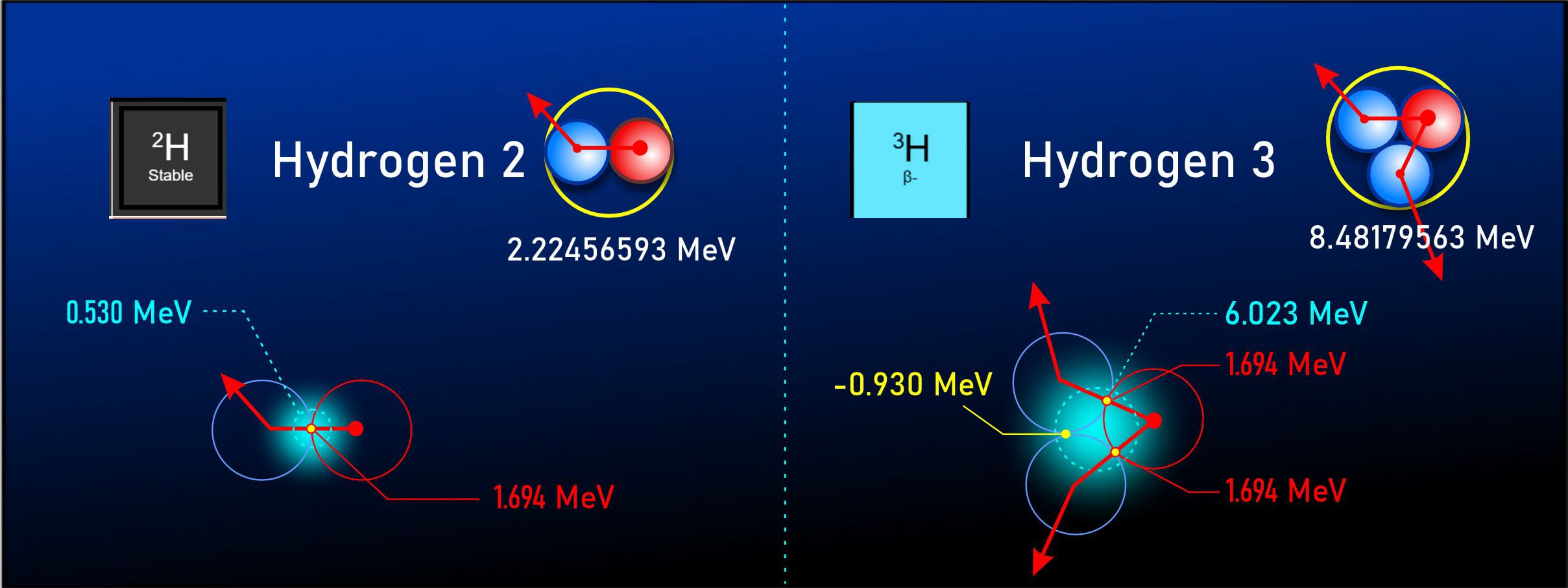
Hydrogen-2 comprises a proton and a neutron, with a total measured binding energy of 2.22456593 MeV. The LGA model posits that the positive proton attracts the negative quarks within the neutron, combining to form a circuit chain with an baseline electrical attraction of +1.69407496 MeV.
The remaining balance of 0.530490970 MeV represents the base gravitational attraction value that exists between all nucleons within a nucleus. Unlike electrical charges, which remain uniform at identical distances, this gravitational value is subject to tidal variations that can increase or decrease based on the distance from the center of mass. These core rules serve as the foundation for all isotope calculations within the LGA Model.
Hydrogen-2 features 1 distinct kiss point evaluated using the baseline formula: Charge + (Gravity × Tide Value) = MeV
Kiss point 1 (P1~N1): +1.69407496 MeV+ (0.53049097 × 1) = 2.22456593 MeV
Total Calculated Binding Energy: Sum of all kiss points = 2.22456593 MeV
Hydrogen-3 (Tritium)
Hydrogen-3 consists of two neutrons and one proton, with a total measured binding energy of approximately 8.48 MeV. Because there is no simple scaling ratio that applies uniformly across isotopes, the measured value must be deconstructed using the established framework of the LGA Model. This requires identifying the physical contact points, termed "Kiss points," and calculating their localized values based on inter-nucleon relationships.
A key insight revealed by the H3 isotope is the negative potential of -0.93 MeV between the neutron pair. This is derived by comparing it to 3He, which shares a comparable structural geometry; deducting these known values from the total measured binding energy isolates the localized repulsive force.
Hydrogen-3 features 3 distinct kiss points evaluated using the baseline formula: Charge + (Gravity × Tide Value) = MeV
Kiss point 1 (P1~N1): +1.694 MeV + (0.5305 MeV × 3.7852) = 3.702 MeV
Kiss point 2 (P1~N2): +1.694 MeV + (0.5305 MeV × 3.7852) = 3.702 MeV
Kiss point 3 (N1~N2): -0.930 MeV + (0.5305 MeV × 3.7852) = 1.078 MeV
Total Calculated Binding Energy: Sum of all kiss points = 8.482 MeV
(Raw high-precision total: 8.48179563 MeV)
Helium-3
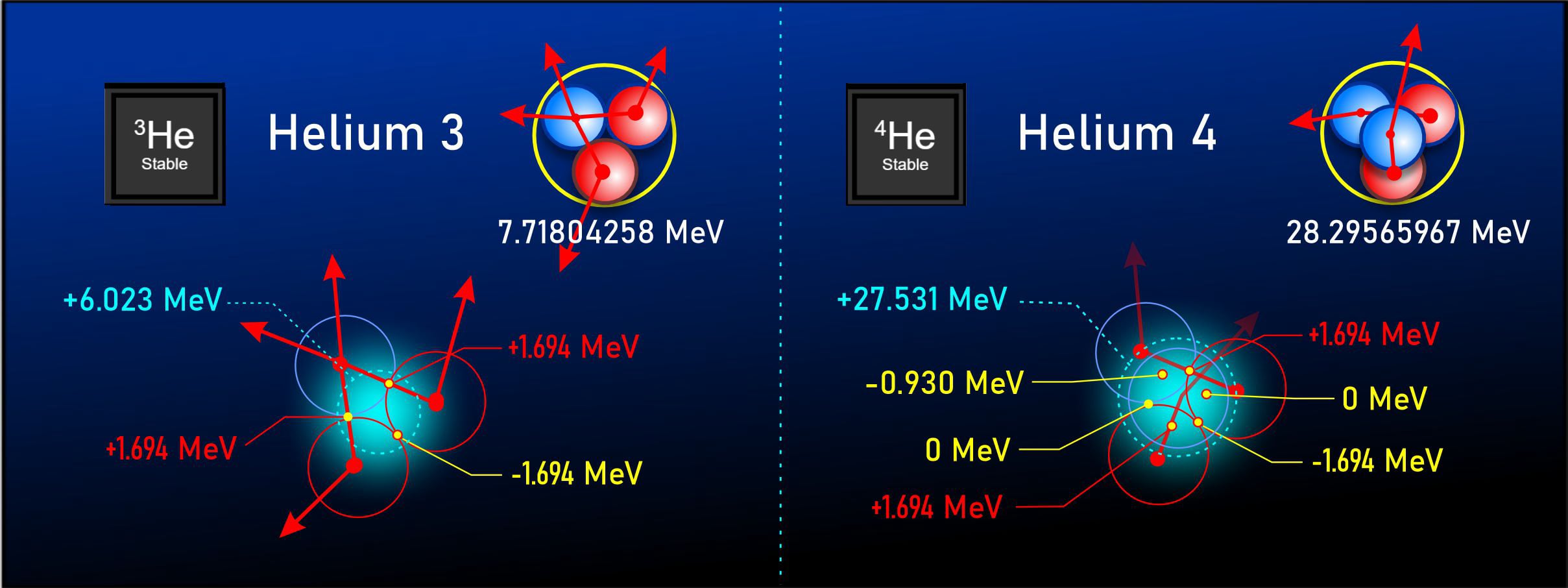
Helium-3 consists of two protons and one neutron, with a total measured binding energy of approximately 7.718 MeV. Utilizing the foundational framework established in the H2 model, we incorporate two positive charge values of +1.694 MeV and introduce a negative repulsive charge value of -1.694 MeV assigned specifically to the proton-proton pairing.
The resulting net energy balance illustrates how local gravitational influence increases threefold upon the addition of a single nucleon. This mechanism represents the LGA Model's tidal effect in action, yielding a gravitational baseline value applicable to H3.
Helium-3 features 3 distinct kiss points evaluated using the baseline formula: Charge + (Gravity × Tide Value) = MeV
-Kiss point 1 (P1~P2): -1.694 MeV + (0.5305 MeV × 3.7852) = 0.314 MeV
-Kiss point 2 (P1~N1): +1.694 MeV + (0.5305 MeV × 3.7852) = 3.702 MeV
-Kiss point 3 (P2~N1): +1.694 MeV + (0.5305 MeV × 3.7852) = 3.702 MeV
Total Calculated Binding Energy: Sum of all kiss points = 7.71804258 MeV
Helium-4 (Alpha particle)
Helium-4, also known as the alpha particle, comprises two protons and two neutrons, with a measured binding energy of 28.2956597 MeV. What is unique about this nucleus is its unusually high binding energy—a feature that the traditional Liquid Drop Model (LDM) fails to calculate accurately, yielding an error rate between 29% and 77% depending on the version used.
The LGA model attributes this energy spike to the distribution of "Kiss points" within the center of mass, where combined gravitational tidal effects are strongest. This tidal effect is a key feature for explaining the distribution of binding energy across all isotopes.
Helium-4 features six distinct kiss points evaluated using the baseline formula: Charge + (Gravity × Tide Value) = MeV
-Kiss point 1 (P1~N1): +1.69 MeV + (0.530 MeV × 8.664) = 6.282MeV
-Kiss point 2 (P2~N2): +1.69 MeV + (0.530 MeV × 8.664) = 6.282 MeV
-Kiss point 3 (P1~P2): -1.69 MeV + (0.530 MeV ×8.649) = 2.894 MeV
-Kiss point 4 (N1~N2): -0.93 MeV + (0.530 MeV × 8.657) = 3.658 MeV
-Kiss point 5 (P1~N2): 0 MeV + (0.530 MeV × 8.657) = 4.588 MeV
-Kiss point 6 (P2~N1): 0 MeV + (0.530 MeV × 8.657) = 4.588 MeV
Total Calculated Binding Energy: Sum of all kiss points = 28.2956597 MeV