Iron
LGA Model
6 key properties govern the structure and binding energy of a nucleus. Understanding these will help science explore the hidden behavior of atoms and lead to new discoveries.
6 key properties govern the structure and binding energy of a nucleus. Understanding these will help science explore the hidden behavior of atoms and lead to new discoveries.
Iron Models Under the LGA Method
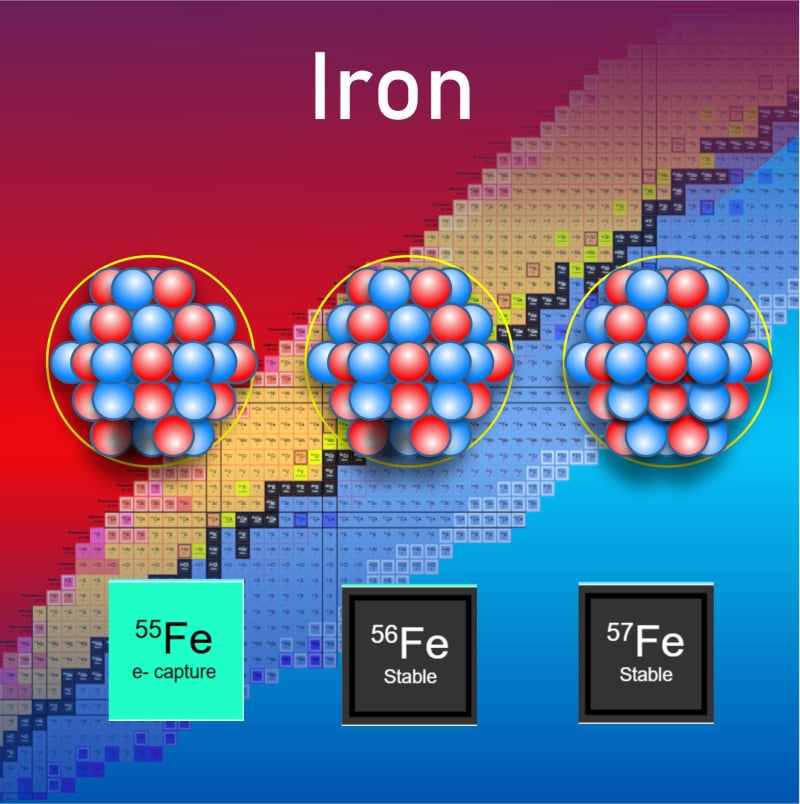
Using the Liquid Gravity Atomic Model (LGA Model), we have mapped three isotopes of iron.
Iron-56 is frequently referenced regarding peak binding energy per nucleon, marking the balancing point between small and large nuclei. This peak also delineates the boundary between fusion and fission—determining whether atoms can be fused together or broken apart. When we compare the three models of iron, we see a highly uniform and symmetrical structure that fits almost perfectly inside a sphere. It belongs to the 5x5x5 structure, which may be a contributing factor to its abundance and stability.
Iron-55
It is understood that Iron-55 (55Fe) is a radioactive isotope of iron that decays into Manganese-55 (55Mn) through electron capture, carrying a half-life of approximately 2.756 years. What might cause an electron capture (e- capture) as opposed to a more typical Beta+ decay?
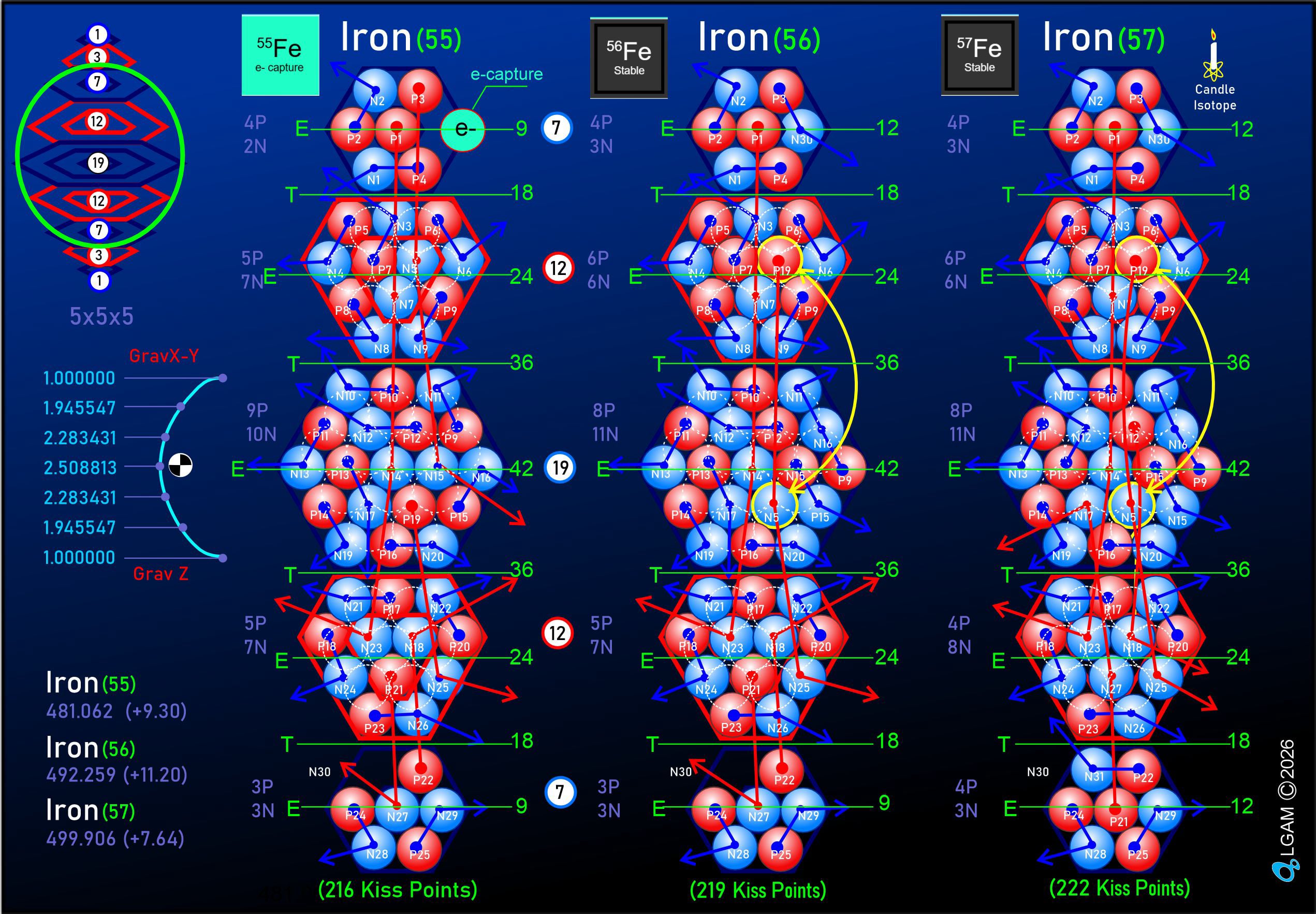
When we study the Liquid Gravity Atomic Model (LGA Model), we see an empty slot surrounded by three protons in the top layer of the structure. We can deduce that this collective positive force would be highly attractive to an oppositely charged electron or a neutron's negative quarks. This specific behavior will need to be confirmed through further study of other models that share the same electron capture traits.
Iron-56:
This isotope is widely cited as being at the peak of binding energy per nucleon (BEpN); however, that title actually belongs to Nickel-62. In modeling these, we also discover that there are distinct odd and even BEpN variations between the isotopes. This is traditionally considered to be caused by spin-pairing between two nucleons with opposite pairs, which favors even numbers over an odd number with an unpaired nucleon.
Within the Liquid Gravity Atomic Model (LGA Model), completely uniform structures can have odd numbers—such as Iron-57—however, the pairing factor must produce a slightly higher consolidation of all nucleons to yield an increased binding energy per nucleon.
Iron-57:
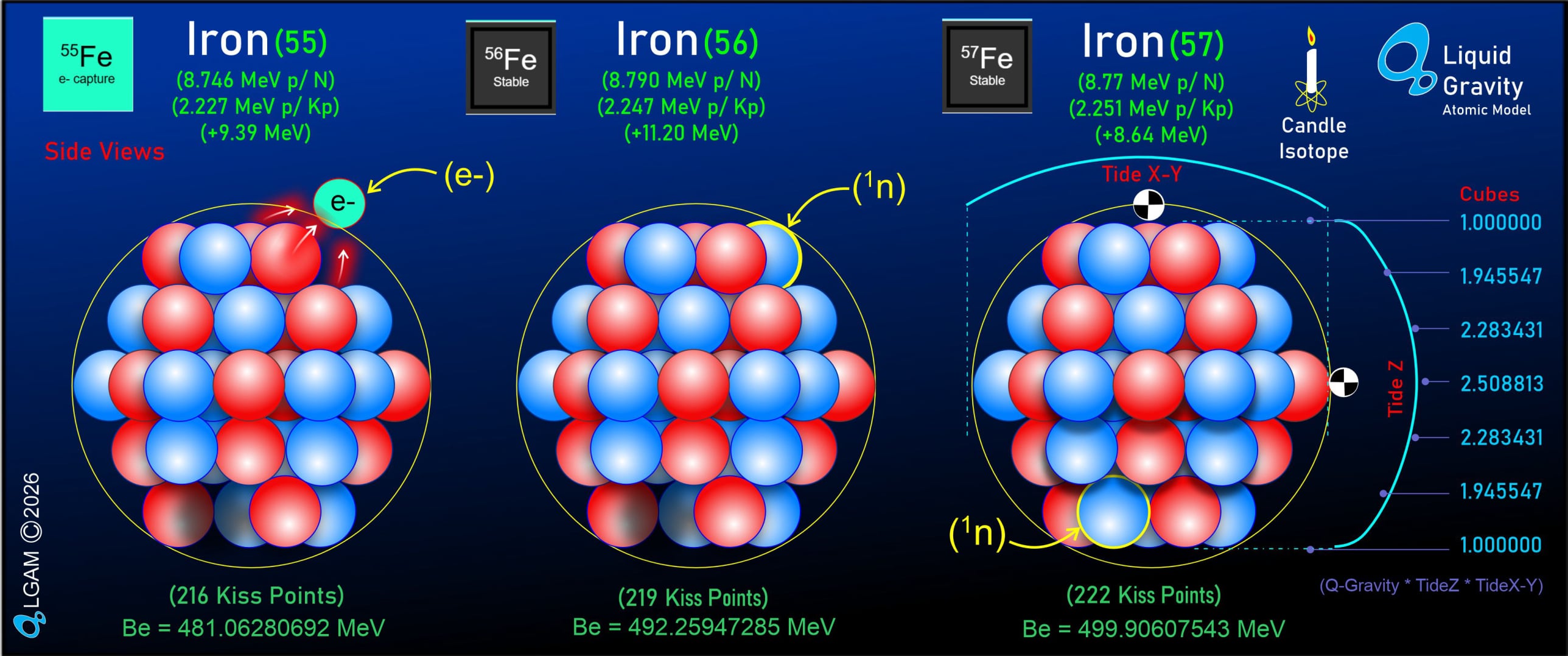
Iron-57 (57Fe) is a stable, naturally occurring isotope of iron that accounts for approximately 2.12% of all iron found on Earth. It is significantly less common than Iron-56 (91.75%). The Liquid Gravity Atomic Model (LGA Model) identifies this isotope as a "candle isotope" due to its complete and symmetrical structure. We can use this model to produce a gravitational curve that fits uniformly across the X, Y, and Z axes. This provides a waypoint for tracking gravitational distribution from small nuclei to larger nuclei.
Note on Tide-Z: The numbers listed under the heading Tide-Z represent the gravitational cube values. These calculate the relative gravitational values at each kiss point based on their location relative to the gravitational curve.
The circuits of iron isotopes quickly become complex, featuring multi-layered connections extending in numerous directions. See the rules that are used to create the nucleus circuit diagram
To model this, we utilize a structural template that best fits the specific nucleon count. For iron, this is typically represented by a 5×5×5 grid (5 layers high by 5 nucleons wide and 5 nucleons deep).
According to the stacking rules, protons are placed in alternating spaces due to electromagnetic repulsion, typically maintaining a single "kiss-point" connection between any two protons. As you compile the structure, you will find that incorporating more protons requires additional connections to complete the stacking process. Furthermore, protons tend to concentrate toward the exterior boundaries and avoid the center, strictly adhering to the laws of electromagnetic attraction and repulsion. Note that this stacking layout may need to adapt as you progress into the circuit-linking stage.
The primary objective of linking is to establish circuits that effectively discharge the positive charge of each proton. This charge attracts the negative quarks within nearby neutrons, causing protons and neutrons to pair up with their closest neighbors. When excess neutrons are present, they attach to an existing neutron chain, thereby extending the circuit length. These chains can branch across multiple layers with multiple "legs." Crucially, these connections must run in a similar direction and can only link nucleons that share a physical kiss-point. For stable isotopes, there may be only one viable configuration where all links function successfully. If a neutron cannot be linked into a circuit, it becomes a source of β− (beta-minus) decay.
Gravity naturally accumulates toward the center of mass. Because the iron nucleus forms a near-perfect sphere, its gravitational profile presents a predictably smooth, multi-directional curve. This gravitational force increasingly compresses and expands the kiss points closer to the center of mass, translating directly into higher binding energy. This phenomenon is known as the tidal effect, and it serves as the primary force shaping the nucleus.
By utilizing the circuit diagram, we can map every kiss point and isolate the precise relationship between any two nucleons. Each distinct relationship possesses both specific charge values and gravitational values. From this, we compile a master list of all kiss points and calculate their individual MeV values based on these localized parameters.
We validate the model by comparing our compiled kiss-point values against the total empirically measured binding energy to check for a precise correlation. If discrepancies arise, we iteratively rearrange the core configuration until it aligns with the empirical data. Most localized fluctuations between isotopes occur in the outermost top and bottom layers, where stronger electromagnetic repulsion can push nucleons apart, resulting in fewer active kiss points.
A critical diagnostic tool is tracking the incremental variance in MeV across models. If the MeV values shift dramatically, it signals a major structural step change. We observe exactly this phenomenon when analyzing Iron-55 (55Fe), Iron-56 (56Fe), and Iron-57 (57Fe). While the baseline average increase is +8.76 MeV per nucleon, the specific step changes register at +9.39 MeV for 55Fe, +11.20 MeV for 56Fe, and +8.64 MeV for 57Fe. This distinct spike indicates that Iron-56 undergoes a unique structural optimization compared to its neighboring isotopes.
Note: These three specific Iron isotope models are still undergoing development. They have not been fully completed, cross-compared, or empirically verified at the time of this publication.
Why are Iron and Nickel at the Peak of Binding Energy per Nucleon?
The Mainstream View: The Liquid Drop Model
Mainstream science suggests that nuclear stability is determined by a baseline battle between the attractive strong nuclear force and the repulsive electromagnetic force between positively charged protons. This creates two distinct phases across the periodic table:
Smaller Atoms:
These nuclei have fewer fully embedded nucleons (protons and neutrons). Because a high proportion of their nucleons sit on the surface, they have fewer neighbors to interact with, which reduces the overall stabilizing effect of the strong force.
Larger Atoms:
As nuclei grow, the strictly limited range of the strong force becomes overrun by the cumulative, long-range repulsive effects of the electromagnetic force.
These ideas are mathematically detailed in the Liquid Drop Model. While this framework provides an approximate explanation of general trends, it fails to provide highly accurate modeling for very small nuclei. Furthermore, it struggles to explain exotic "halo nuclei"—nuclei with neutrons or protons that orbit far outside the core, seemingly past the traditional limits of the strong force.
An Alternative Framework: The Liquid Gravity Model (LGA)
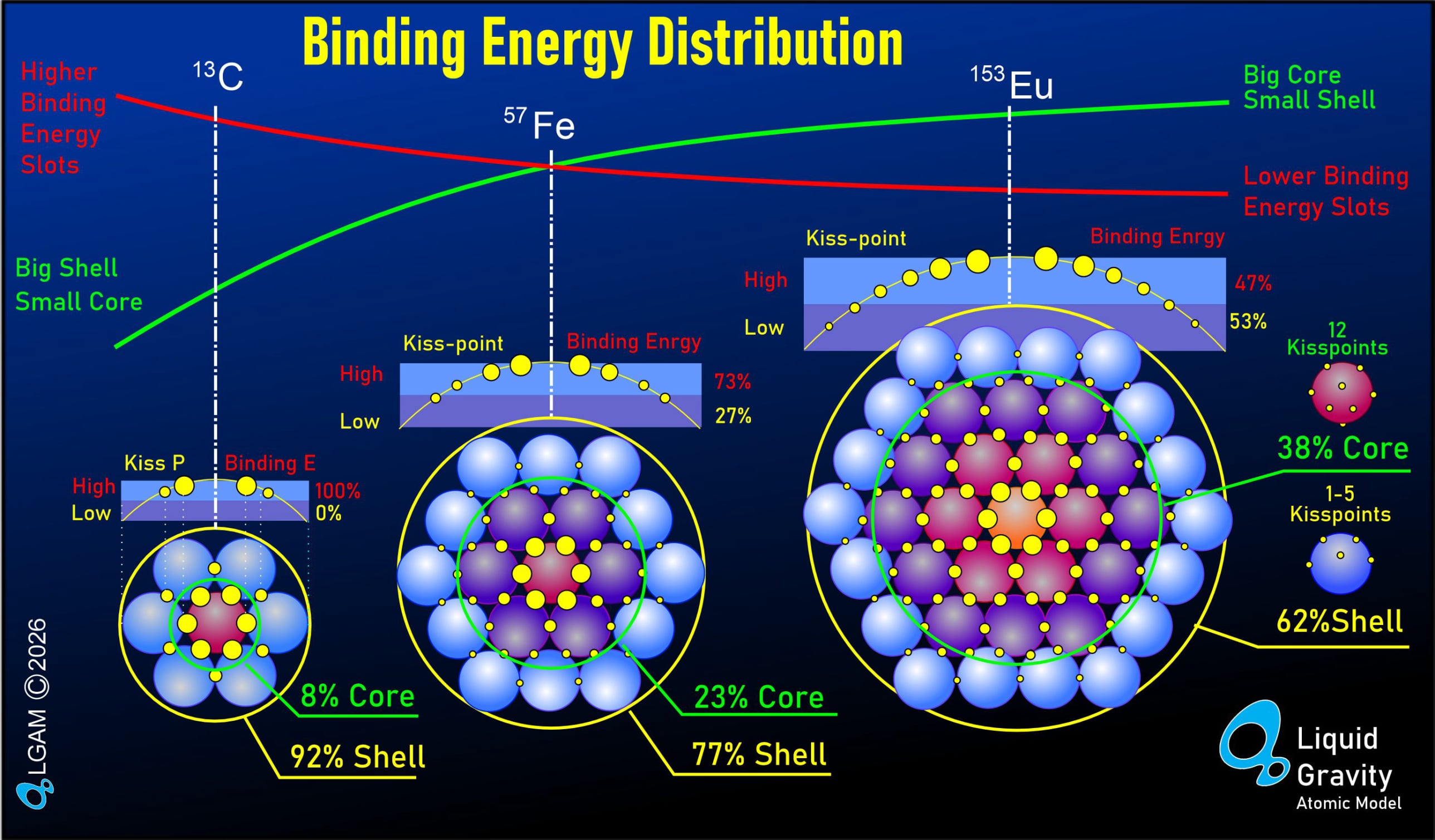
The Liquid Gravity Model (LGA) provides an alternative explanation for this nuclear curve. Like the mainstream view, the LGA model considers two opposing forces at play: electromagnetic repulsion pushing protons apart, and gravity pulling all nucleons together.
However, where the traditional strong force is considered uniform in its range and distribution, the LGA model views gravity as inherently "clumpy" at the subatomic scale:
The Core:
Gravity consolidates heavily around the nucleus's center of mass, exponentially increasing the strength of the binding energy toward the center.
The Shell:
Around the outer edges of a nucleus, the collective electromagnetic forces gain a greater relative influence.
In smaller nuclei, the presence of multiple gravitational clusters accounts for the erratic, fluctuating binding energies observed in light elements. In larger atoms, gravity consolidates into a single, centralized cluster, resulting in a much smoother distribution of force.
The Mechanics of the LGA Model
The LGA model identifies two key structural parameters that shift to produce the famous binding energy per nucleon curve:
1. The location of "Kiss Points" (contact points between nucleons) relative to the internal gravitational gradient.
2. The ratio of shell nucleons versus core nucleons. -Shell nucleons on the exterior have between 1 and 5 "kiss point" connections, whereas a fully embedded core nucleon has 12.
Achieving Equilibrium: Iron and Nickel
Under the LGA Model, Iron and Nickel represent the perfect equilibrium where surface area and core volume are completely balanced:
Small Nuclei have a proportionally larger, low-connection shell area, but this is compensated for by the fact that their nucleons are structurally closer to the high-gravity center of mass.
Large Nuclei boast massive cores with maximum (12-point) connections, but their outer shells occupy increasingly weaker, distant gravitational bands. This gradually reduces the average binding energy per nucleon, causing the downward slope seen in heavy elements.
| Feature | The Mainstream View: Liquid Drop Model | The Alternative Framework: Liquid Gravity Model (LGA) |
|---|---|---|
| Opposing Forces | Strong Nuclear Force (attractive, short-range) vs. Electromagnetic Force (repulsive, long-range). | Gravity (attractive, "clumpy" at subatomic scale) vs. Electromagnetic Force (repulsive). |
| Behavior in Small Nuclei | Lower binding energy because a high proportion of nucleons sit on the surface, meaning fewer neighbors to interact with via the strong force. | Erratic binding energy due to multiple, separate subatomic gravitational clusters. Nucleons are physically closer to the high-gravity center. |
| Behavior in Large Nuclei | Lower binding energy because the short-range strong force is overwhelmed by the cumulative, long-range repulsion of protons. | Lower binding energy because gravity consolidates into a single central core, leaving the outer shell nucleons in weaker, distant gravitational bands. |
| Why Iron/Nickel is the Peak | It represents the ideal tipping point where the attractive strong force maximizes its efficiency before proton-proton repulsion dominates. | It is the perfect equilibrium point where the surface area (outer shell) and core volume are completely balanced. |
| Nucleon Connectivity | Characterized by a general baseline interaction based on distance and proximity. | Defined by "Kiss Points" (contact points). Core nucleons have 12 connections; shell nucleons have only 1 to 5. |
| Model Limitations | Fails to model very small nuclei accurately and struggles to explain "halo nuclei" that orbit far outside the core. | Not accepted by mainstream physics; redefines gravity as a dominant, localized force at the subatomic scale. |
Key Takeaway: Both models identify Iron and Nickel as structural "sweet spots." The Liquid Drop Model highlights a balance between two competing forces, while the Liquid Gravity Model frames it as a geometric equilibrium between a 12-connection core and its surrounding shell.