3D Nucleus Modelling
Exploring the Nuclear Architecture
There are a wide range of theories regarding the structure of the atomic nucleus—spanning from the Liquid Drop Model, which visualizes a vibrating bag of nucleons, to the formal geometric approaches of the Shell Model. More recently, the Structured Atomic Model (SAM) produced an excellent 3D visualization tool to present its ideas on nuclear configurations.
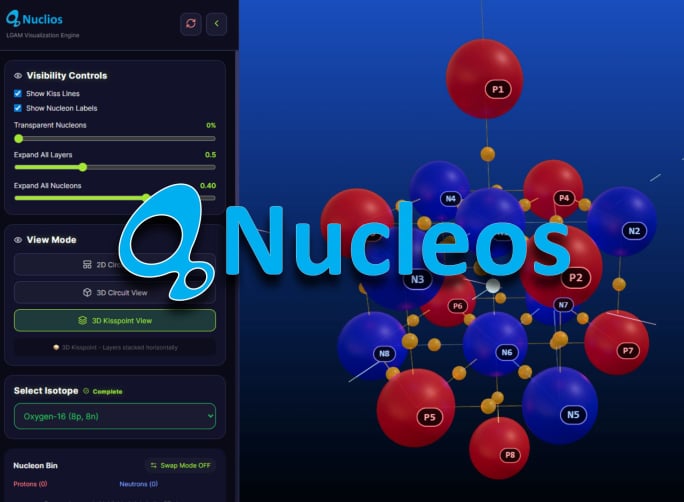
Inspired by these advancements, we are building Nucleos—a powerful software platform designed to explore and validate the Liquid Gravity Atomic (LGA) Theory.
The Nucleos Advantage: Precision and Granularity
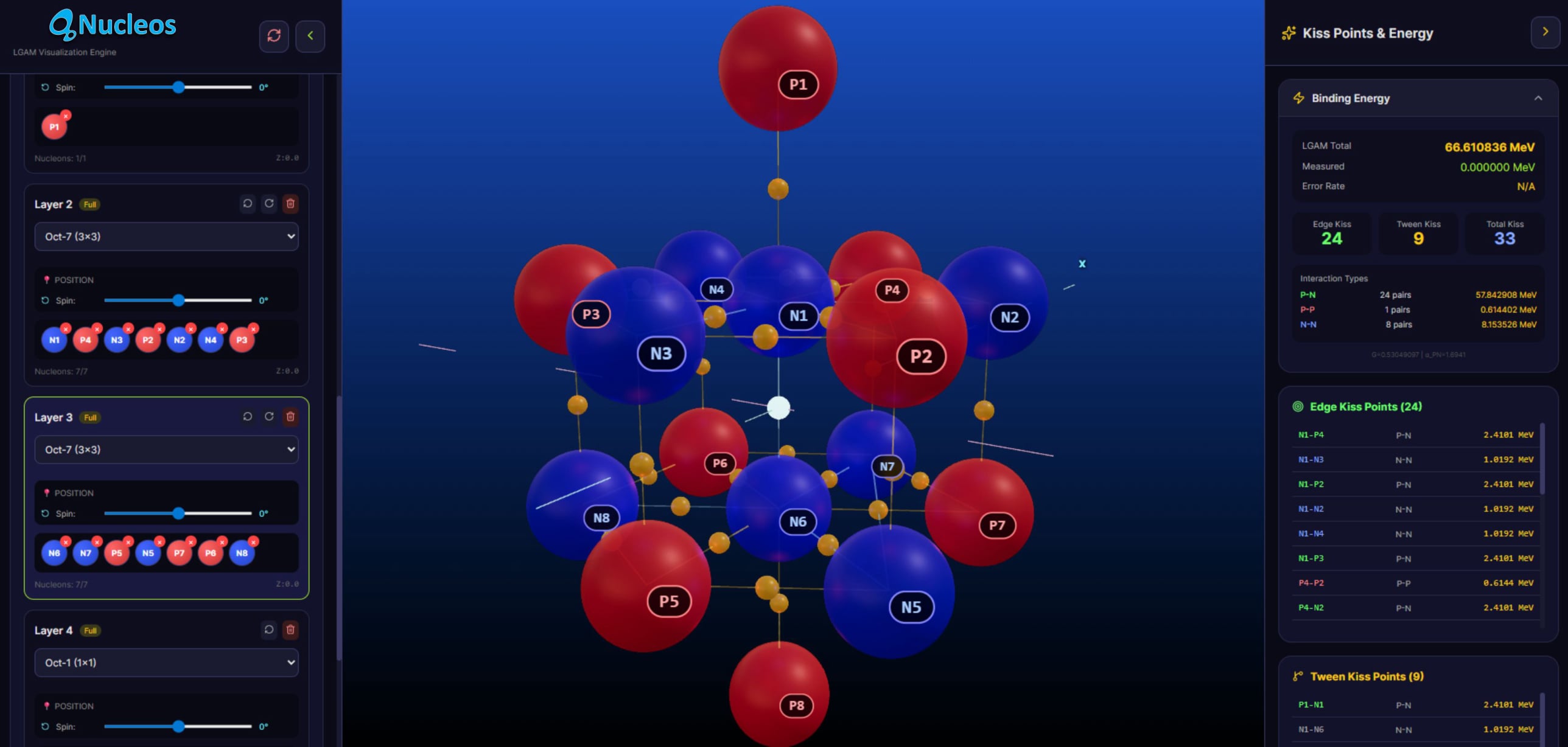
Because our platform drills down into the individual touchpoints of every single nucleon, we can map out a significantly higher resolution of vector data to visualize nuclear forces. The Nucleos framework operates on nested, interlocking structural layers. By applying the fundamental laws of gravity alongside electromagnetic attraction and repulsion, the software derives structural configurations that we believe accurately depict physical nuclear formations.
Unlike conventional atomic models that only calculate the average binding energy per nucleon, our method isolates the unique binding energy for every individual nucleon. This level of granularity provides deeper insight into how these structures form and the precise localized stresses that trigger isotopic instability.
An Algorithmic Discovery Tool
Nucleos functions as an interactive assembly tool, allowing researchers to build isotopes and test different geometric configurations to find the exact match for empirically measured binding energy data. Each resolved isotope unlocks the structural logic needed to model more complex and exotic elements.
Furthermore, these methods do not rely on traditional magic numbers. Instead, they uncover the explicit structural features and geometric symmetries that naturally give rise to the data patterns observed across the table of isotopes.
Join the Journey
Our goal is for Nucleos to become both a premier educational platform and a cutting-edge research tool for investigating new or exotic is
otopes.
If you are interested in utilizing this software or partnering with us on this research, we would love to hear from you. Drop us a line today!