Hidden Properties
Equivalents of Gravity, Charge, and Binding Energy
Mainstream science treats gravity, charge, and binding energy as distinct phenomena, describing each through its own unique set of laws, equations, and units. Conversely, the LGAM integrates these forces, utilizing binding energy as a unifying metric that quantifies the collective interactions within the atomic nucleus.
In this framework, binding energy represents the "missing mass" of the nucleus, displaced by opposing forces acting at the localized contact points ("kiss points") between nucleons. By identifying the forces at each kiss point and mapping them to corresponding MeV values, the LGAM clarifies how these distinct forces interact, offering a high-resolution, highly accurate view of nuclear dynamics. Ultimately, the model relies primarily on gravity and charge, attributing measurable MeV values to their respective influences.
What about the strong force?
Conventional physics relies on the strong force to describe interactions between quarks and gluons, suggesting that a "residual" strong force binds nucleons together at short distances. The LGAM, however, proposes that gravity and electromagnetic forces are what actually bind nucleons. In this model, the strong force is interpreted as a localized hydraulic force generated by the vortices spinning between quarks, which operates independently and does not impact the overarching binding energy.
Gravitational Tidal Effects
Nucleonic charges exhibit a diverse spectrum of values—ranging from attraction and neutrality to strong repulsion—which interact uniformly throughout the nucleus. In exceptionally small atoms, these localized charge forces can dominate, driving the formation of halo and crested nuclei.
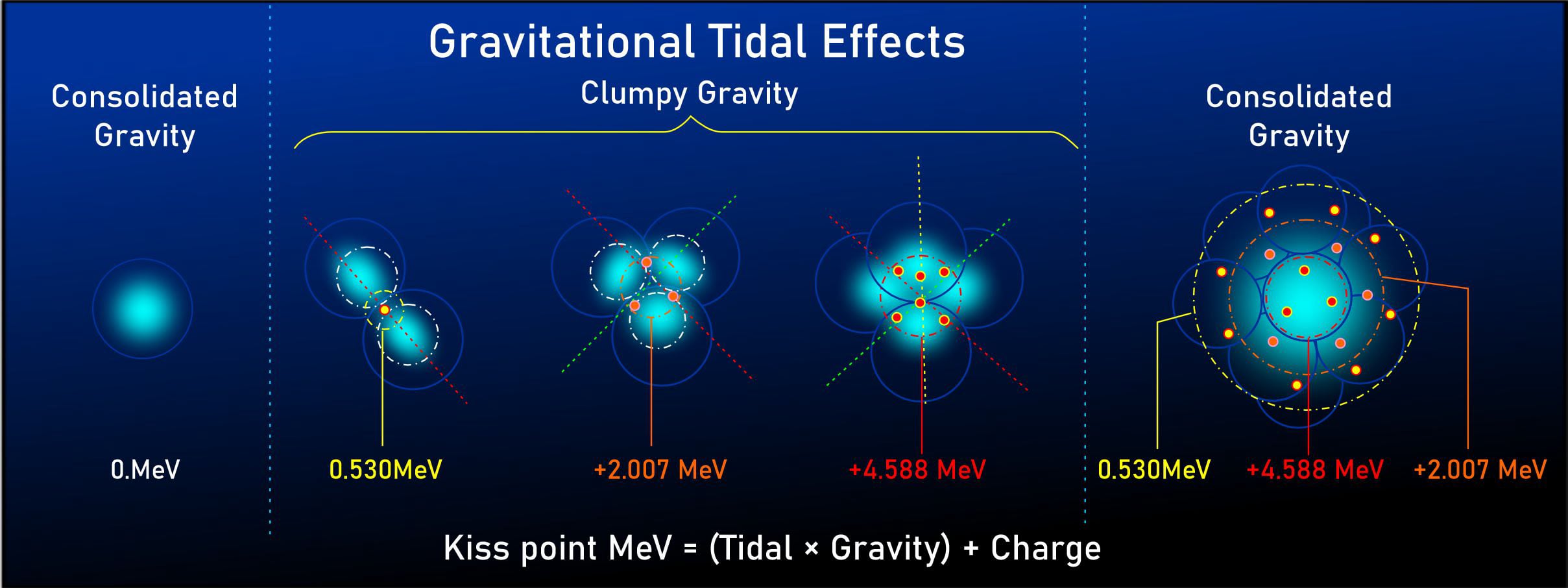
Conversely, for the majority of atoms, gravity exerts primary structural control; gravitational strength escalates as nucleons accumulate, organizing the cluster into its spatial geometry. Smaller atoms possess more localized, "clumpy" gravitational zones that exert a dramatic effect on structural geometry. In contrast, larger atoms exhibit consolidated gravity that uniformly increases from the outer layers toward the core. Consequently, larger atoms feature progressively weaker gravitational outer layers, allowing charge forces to become dominant over gravity and leading to structural instability.
Larger Candle Isotopes
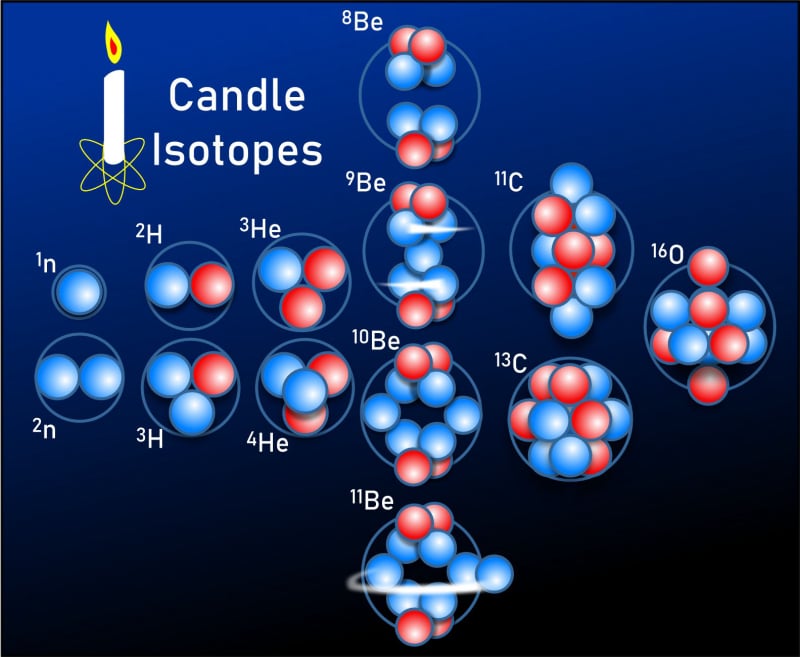
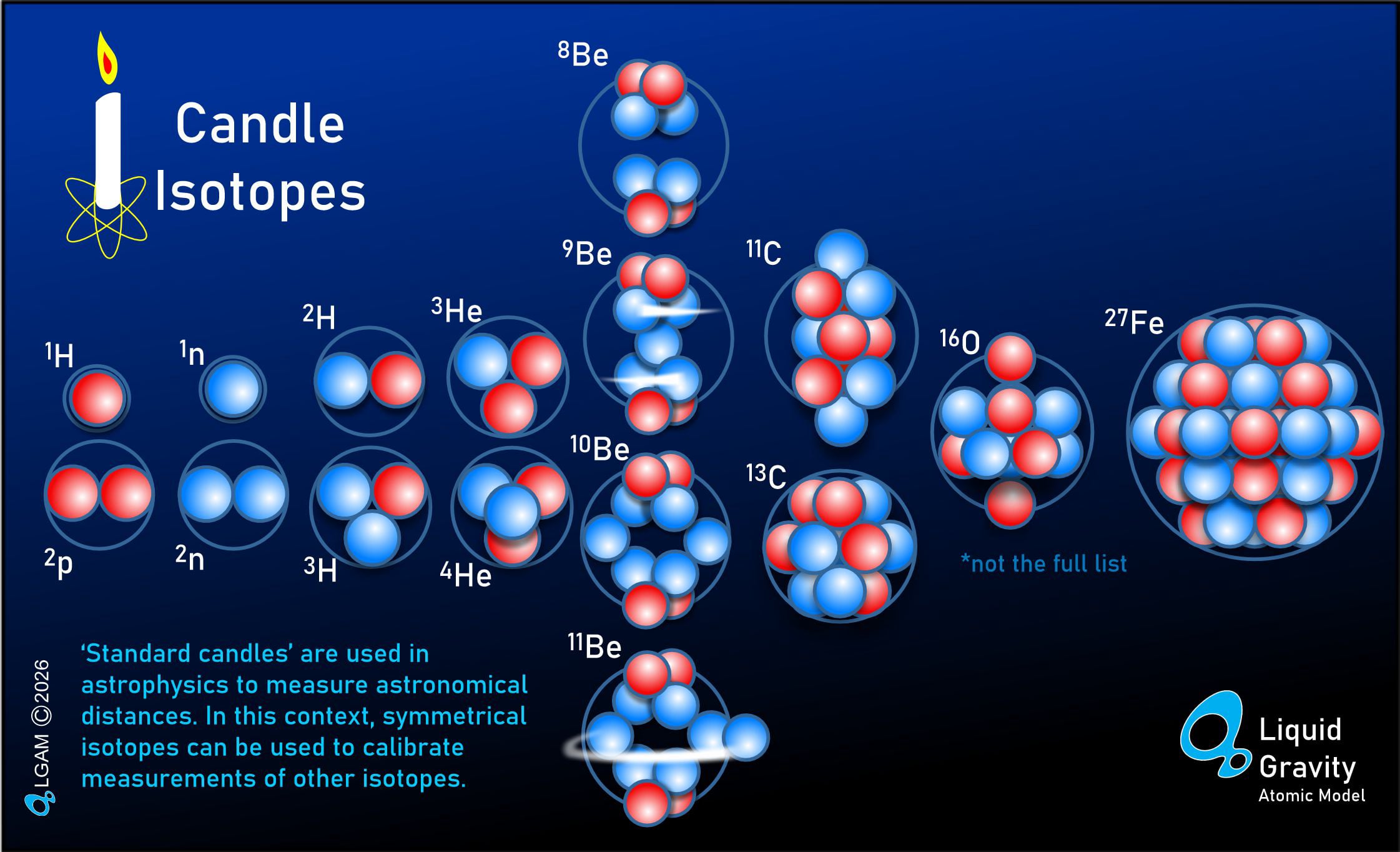
While the LGAM currently lacks a closed-form equation to calculate this gravitational transition across the periodic table, it utilizes the aforementioned Candle Isotopes to empirically derive these values. At this larger scale, Candle Isotopes are defined by their complete sets of structural levels, providing a uniform, symmetrical calibration reference that can be systematically transitioned to the next Candle Isotope reference point.
Gravitational Distribution
The diagram below illustrates how gravity distributes across multiple nucleons, transitioning from a clumpy architecture in smaller atoms to a consolidated structure in larger ones. Binding energy is primarily influenced by the spatial location of the kiss points relative to this gravitational gradient. This mechanism explains why the Liquid Drop Model (LDM) demonstrates higher accuracy with larger atoms—where the gravity distribution is regular—yet suffers from low predictive accuracy for smaller, gravitationally clumpy elements.