NucliViz

Nuclear Visualization
Engine 

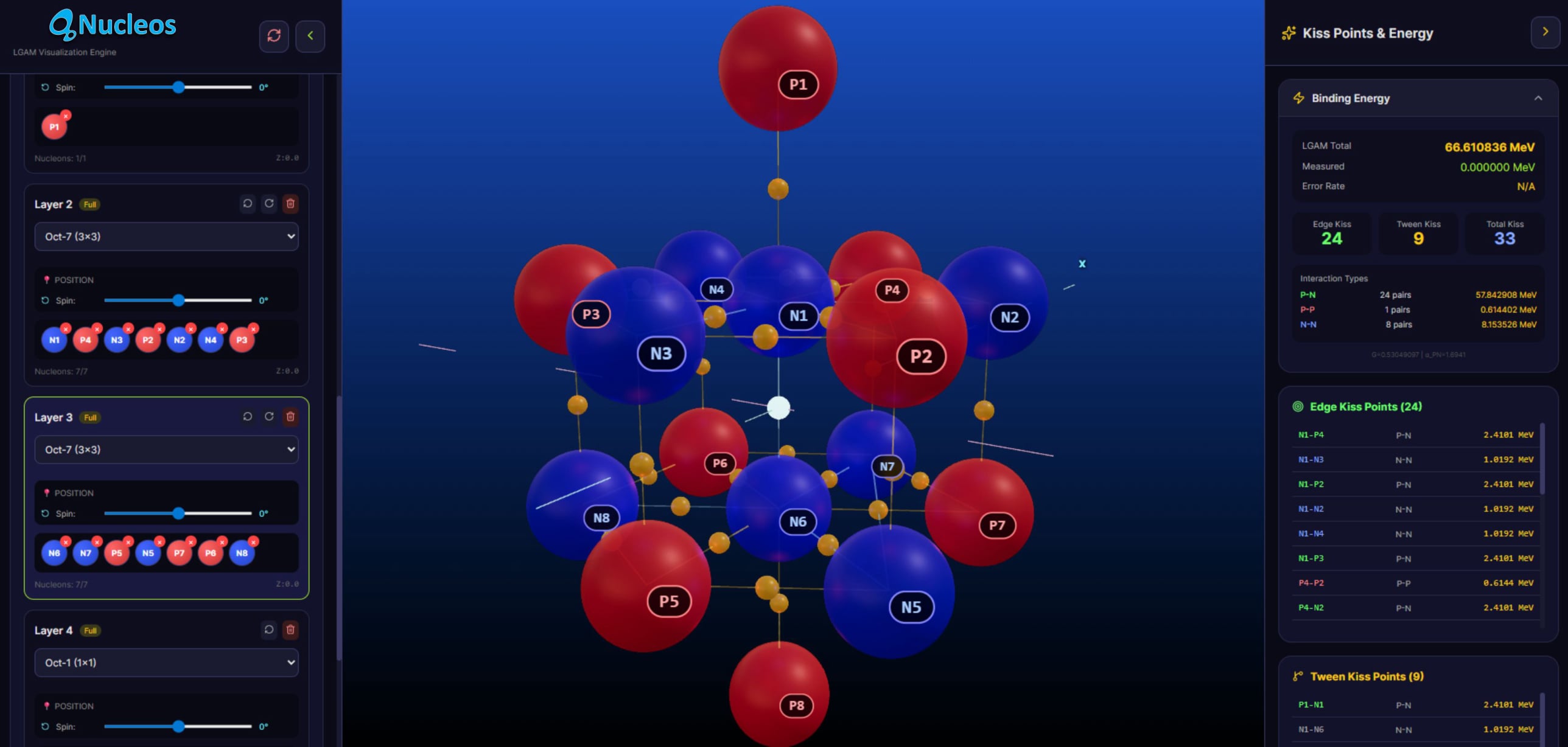
Visualize Atomic Nuclei in Brilliantly Detailed 3D. The Nucleos app peels back the layers of the atom to reveal its inner mechanisms. Leveraging the LGA model, it provides comprehensive data for every nucleon, allowing you to explore nuclear structures like never before.

3D Nucleus Modelling 

Exploring the Nuclear Architecture
There are a wide range of theories regarding the structure of the atomic nucleus—spanning from the Liquid Drop Model, which visualizes a vibrating bag of nucleons, to the formal geometric approaches of the Shell Model. More recently, the Structured Atomic Model (SAM) produced an excellent 3D visualization tool to present its ideas on nuclear configurations.

Inspired by these advancements, we are building Nucleos—a powerful software platform designed to explore and validate the Liquid Gravity Atomic (LGA) Theory.

The Nucleos Advantage: Precision and Granularity
Because our platform drills down into the individual touchpoints of every single nucleon, we can map out a significantly higher resolution of vector data to visualize nuclear forces. The Nucleos framework operates on nested, interlocking structural layers. By applying the fundamental laws of gravity alongside electromagnetic attraction and repulsion, the software derives structural configurations that we believe accurately depict physical nuclear formations.

Unlike conventional atomic models that only calculate the average binding energy per nucleon, our method isolates the unique binding energy for every individual nucleon. This level of granularity provides deeper insight into how these structures form and the precise localized stresses that trigger isotopic instability.

An Algorithmic Discovery Tool
Nucleos functions as an interactive assembly tool, allowing researchers to build isotopes and test different geometric configurations to find the exact match for empirically measured binding energy data. Each resolved isotope unlocks the structural logic needed to model more complex and exotic elements.

Furthermore, these methods do not rely on traditional magic numbers. Instead, they uncover the explicit structural features and geometric symmetries that naturally give rise to the data patterns observed across the table of isotopes.

Join the Journey
Our goal is for Nucleos to become both a premier educational platform and a cutting-edge research tool for investigating new or exotic is
otopes.

If you are interested in utilizing this software or partnering with us on this research, we would love to hear from you. Drop us a line today!

    Open the 3D Isotope Modelling Software

3D Isotope modeling software

Inside the 3D Spin Particle  

The 720° Spin Mechanism (Silver Atom Model)

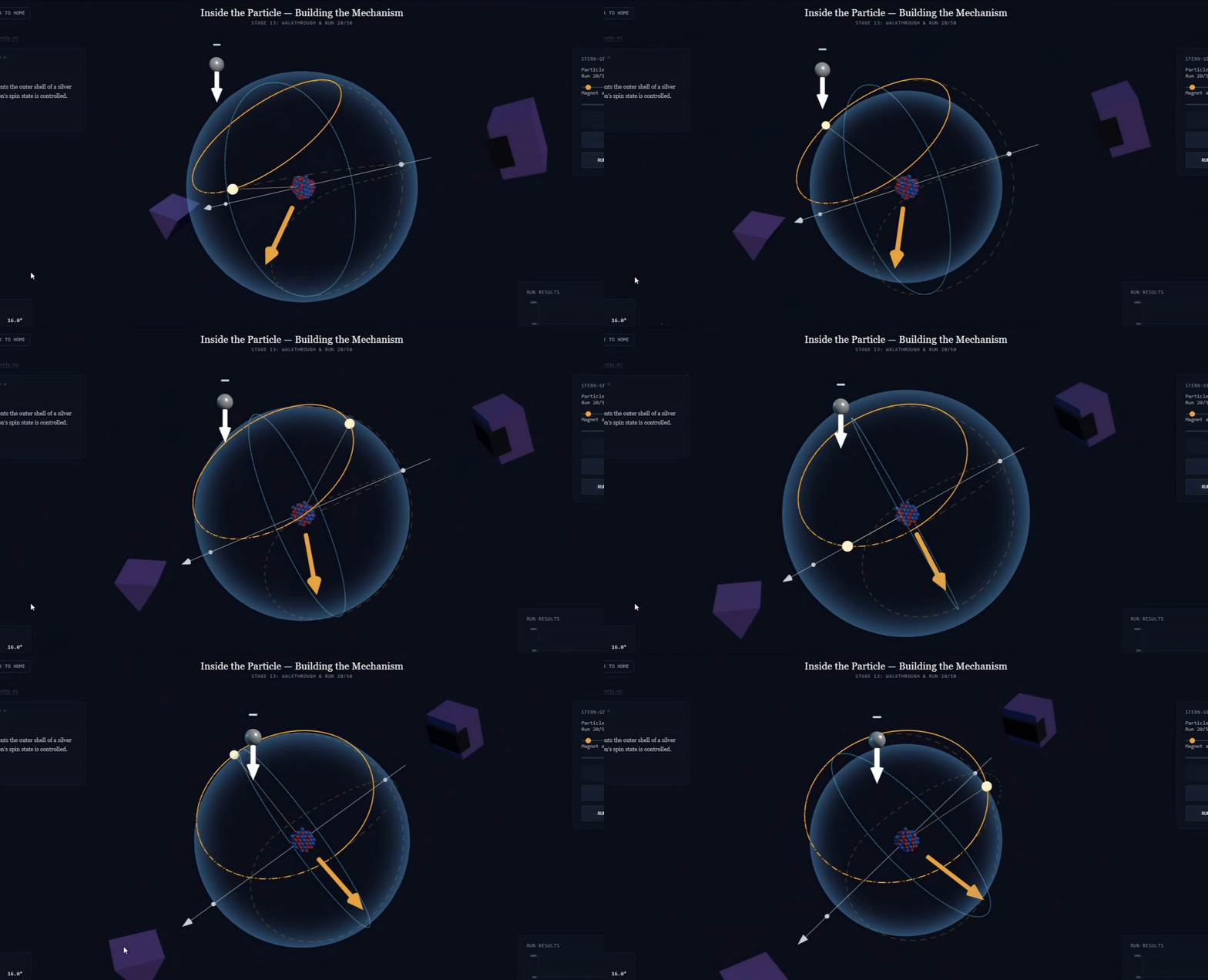
Go inside a single spin-1/2 particle and watch what quantum mechanics textbooks describe but rarely show: a genuine 720-degree rotational structure, not the ordinary 360° you'd expect from everyday geometry. This 3D visualization traces the particle's internal phase as a figure-eight path — a real spinor-like double loop, verified to cross itself at a true right angle — representing the quantum superposition of spin-up and spin-down before any measurement occurs.

Bring in an authentic Stern-Gerlach magnet, modeled with the same asymmetric knife-edge and grooved-trough pole pieces used in a real apparatus, switch it on, and watch the particle's hidden equatorial angle settle into a von Mises distribution around the magnet's own axis, collapsing the 720° superposition into a definite 360° spin eigenstate the moment the 90° threshold is crossed.

At the centre sits a fully modeled silver-107 nucleus, its 47 protons and 60 neutrons genuinely touching in a close-packed lattice with zero gaps, tethered to the particle's phase by a live connecting line to the valence electron. Run 20 or 50 trials in sequence and watch the cumulative statistics converge toward the quantum-mechanical cos²(θ/2) correlation in real time.

Complete with a guided, stage-by-stage walkthrough narrating every element — the polar axis, the equatorial axis, the spin+ and spin− eigenstates, the collapse, and the live roll-over flip — this is one of the clearest hands-on ways to build real intuition for electron spin, quantum superposition, wave function collapse, and the Stern-Gerlach experiment, whether you're a student, a physics enthusiast, or a researcher exploring local hidden-variable alternatives to standard quantum mechanics

  Open the Interactive 3D Atomic Spin Particle.  
Interactive 3D Silver Atom

3D Stern-Gerlach Experiment  

(Sequential Spin Measurement)
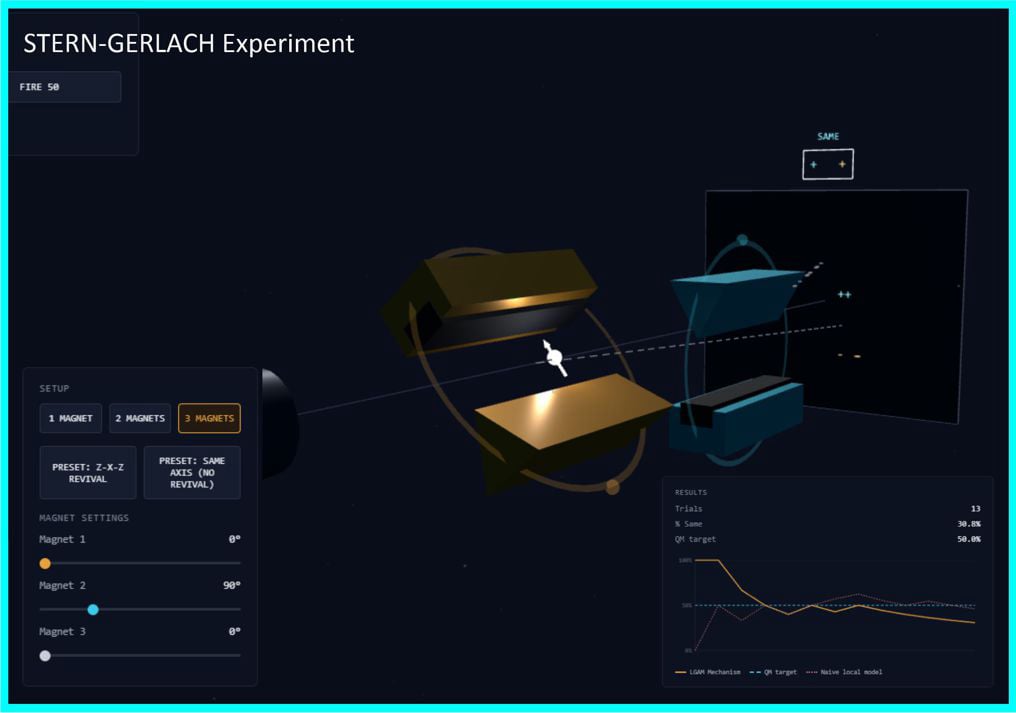
This 3D visualization walks you through the Stern-Gerlach experiment step by step, showing exactly how a single particle's spin is measured as it passes through one or two magnets in sequence. Choose between a single-magnet setup or a two-magnet sequential configuration, adjust each magnet's angle, and fire particles one at a time — or run batches of 20 or 50 — to see how measurement outcomes and blocking probabilities emerge from the underlying mechanism.

A guided walkthrough mode breaks a single trial into six clear stages, from the particle's initial random orientation settling into alignment with the first magnet, through the 90° selection rule governing whether it passes or is blocked at the second, complete with visual spin-state indicators, orientation arrows, and flip animations that make an invisible quantum process visible. It's an ideal tool for anyone studying quantum spin measurement, wave function collapse, or the statistical predictions of quantum mechanics, and for testing how a proposed local hidden-variable mechanism reproduces the same cos²(θ/2) correlation quantum theory predicts. 

    Open the Interactive 3D Stern Gerlach Experiment 

3D Stern Gerlach Experiment

3D Entangled-Pair Experiment

The Six Stages of Causality
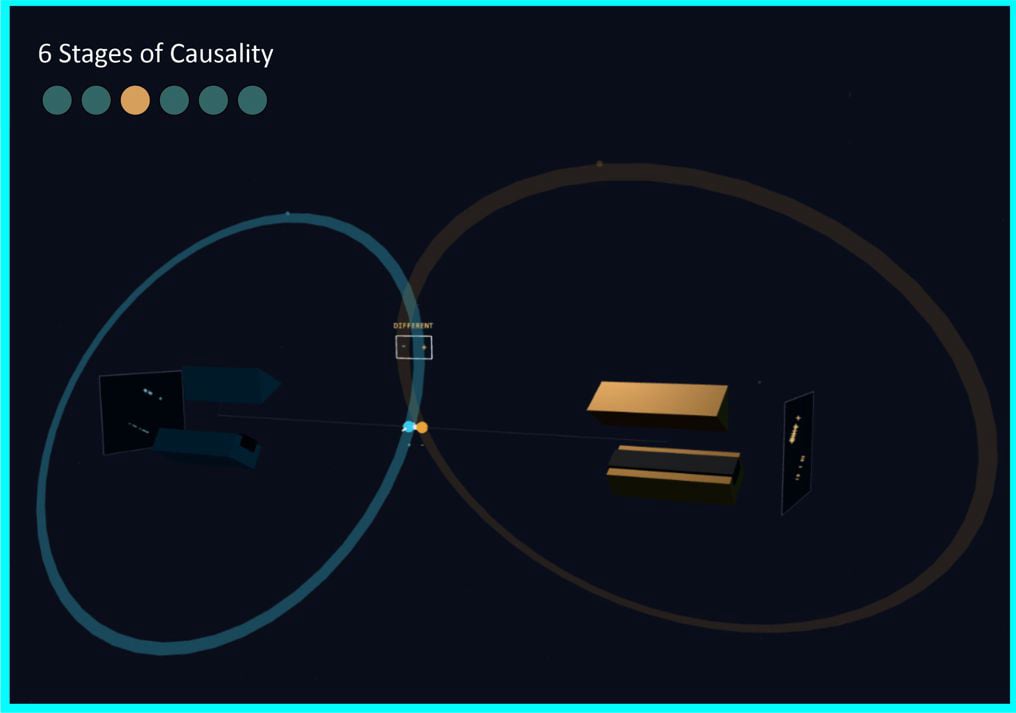
How does one magnet's setting affect a distant, entangled particle without sending a signal faster than light? This 3D demonstration breaks that question down into six explicit, causally-ordered stages, tracing exactly how information about a magnet's angle could reach a particle's measurement outcome purely through local, sub-light-speed interactions — never violating relativity's speed limit.

Watch two magnetic fields expand outward and meet at a shared origin, see how a single generative event locks in a shared hidden variable, and follow that correlation as it propagates outward to each particle before being read out at its own detector. Step through the sequence manually, let it auto-play, or run a fast batch of 50 trials to watch the measured correlation converge toward the quantum-mechanical prediction in real time, alongside a naive local model for comparison. Built for anyone curious about the EPR paradox, quantum non-locality, no-signaling constraints, and how local hidden-variable theories attempt to reconcile entanglement with relativistic causality — no faster-than-light communication required. 

    Open the 3D Interactive Entangled Atoms

3D Interactive Entangled Atoms

2D Entanglement Experiment 

The Proximal Correlation Model
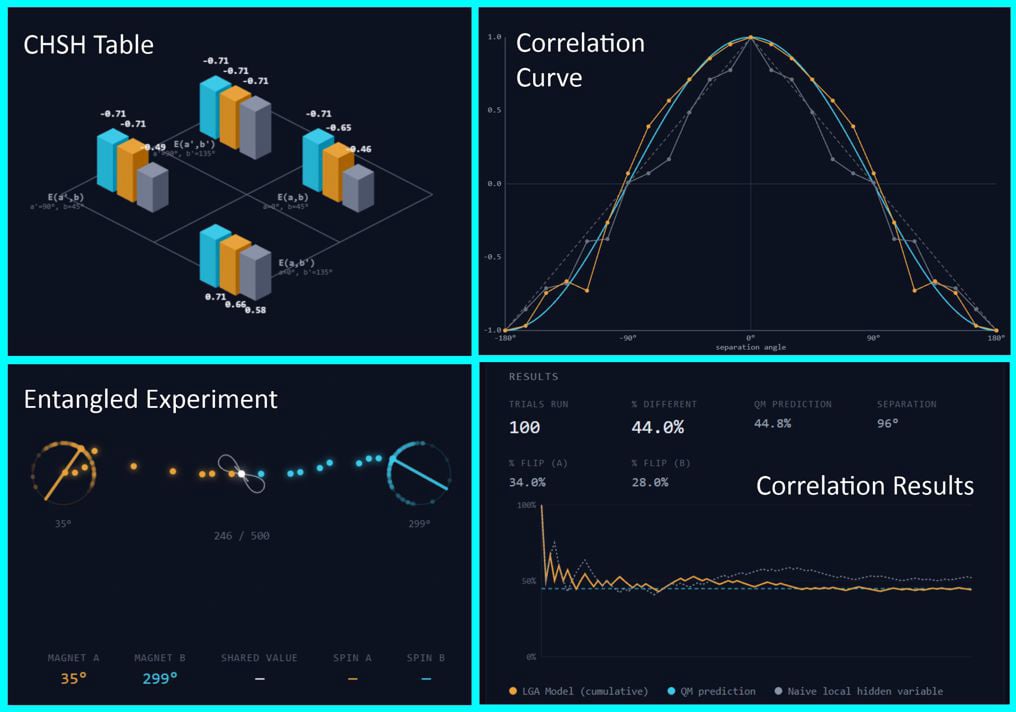
Explore quantum entanglement and Bell's theorem for yourself with this interactive 3D simulation of the classic EPR experiment. Set your own magnet angles, run the trials, and watch two entangled particles produce correlated spin measurements in real time — no formulas assumed, no quantum mechanics called directly. Every outcome is generated by a genuine local hidden-variable mechanism: a particle angle drawn from a von Mises distribution, checked against a 90° threshold, and compared side-by-side against both the standard quantum-mechanical prediction and the naive local hidden-variable model that Bell's theorem famously rules out.

Live charts track how closely the results track the quantum target as trials accumulate, letting you see the statistics converge rather than just reading about them. Whether you're a physics student trying to build intuition for spin correlation and non-locality, or a researcher exploring alternative local-realist models of quantum entanglement, this hands-on demonstration turns an abstract, often confusing thought experiment into something you can manipulate, measure, and verify yourself.

    Open the 2D Interactive Entangled Pair Experiment

2D model of entangled experiment

© 2026 Liquid Gravity Atomic Model