How the LGAM uses it.
The Liquid Gravity Atomic Model (LGAM) offers a different solution. It describes quantum behaviour as a physical interaction between particles across a distance, carried by a property of space-time we call the rod effect. The speed of a wave through a material tells you its stiffness. Light is the fastest wave we know, so space must be the most rigid substance there is, and a very rigid substance passes on a displacement in proportion to its wave speed. Simply put, when one particle in an entangled pair is rotated, the other is rotated by a matching amount, and that produces the quantum probabilities the theory is famous for.
So in the Liquid Gravity model every interaction is a physical event passing between objects, only faster than light. In every other sense it is local. No existing term covers that, and superlocality fits: it keeps locality and marks where it breaks the classical boundary.
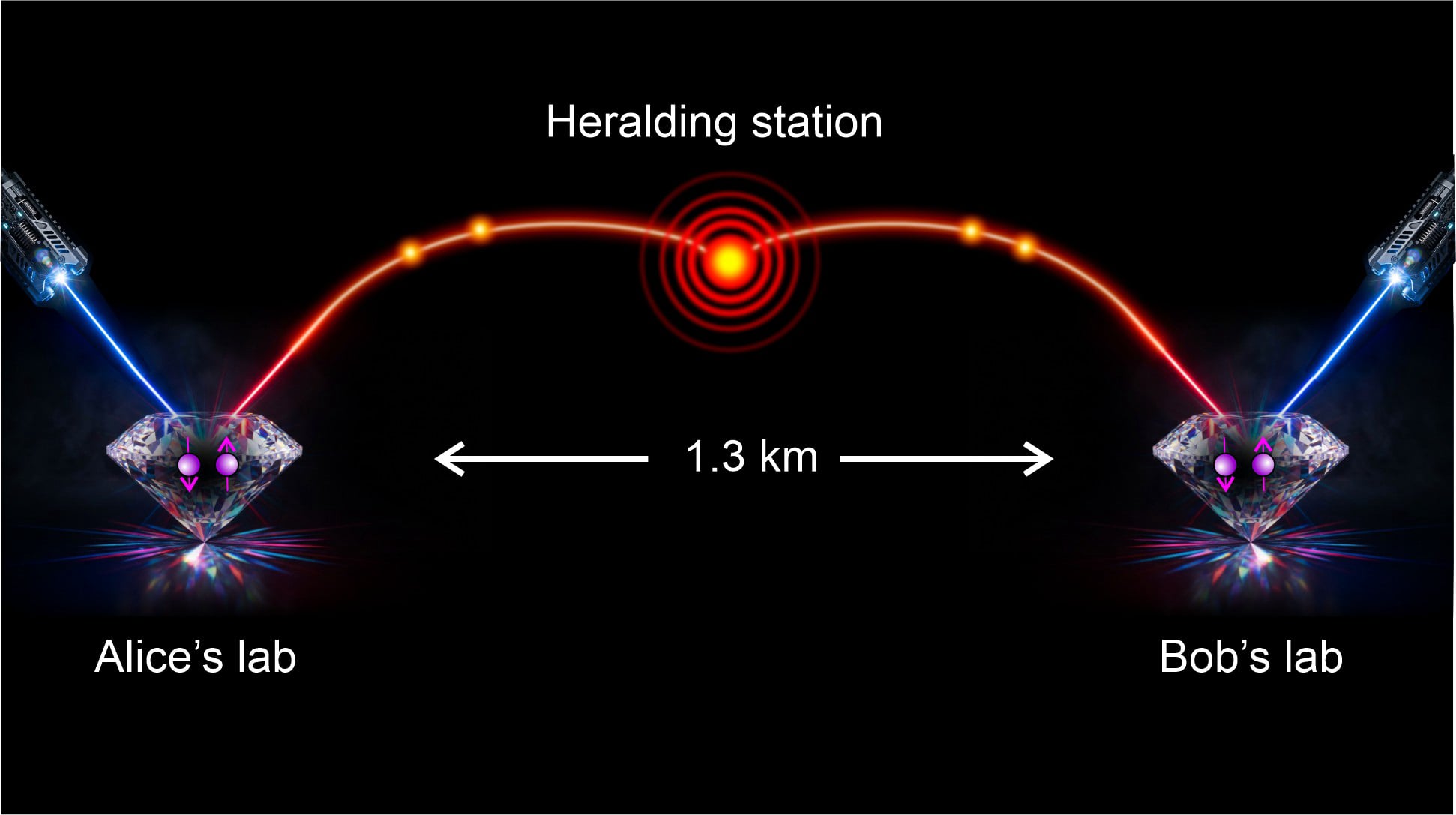
The 2015 Delft experiment is a good place to see it at work. Two labs, about 1.3 kilometres apart, each hold a tiny diamond with a single trapped electron spin inside it. Light from each diamond is sent down optical fibre to a heralding station between them. Only when the station registers a particular detection do the two spins count as entangled, and that happens roughly once in every 150 million attempts. At that moment each lab picks a random measurement setting, which in the Liquid Gravity picture means rotating its particle to a chosen angle, and reads out the spin. The results show a correlation stronger than any local model limited by light speed can explain. In our model, rotating the particle in one lab sends a displacement along the same path the light took, and the other particle is turned by the matching amount. The correlation comes from a physical link that travels faster than light, not from a spooky connection with no path.(Read more Delft page on Nucliviz (nucliviz.org/delft.html)
You can now add superlocality to the list of proposed quantum solutions, next to superdeterminism, retrocausality, the Copenhagen interpretation, many-worlds and pilot-wave theory.